
Which of the following is a straight chain polysaccharide composed only of B-D-glucose units?
Answer & explanation
Correct answer: option 4
The correct answer is Option (4) → Cellulose
Polysaccharides are complex carbohydrates formed by the polymerization of monosaccharide units through glycosidic linkages.
The structure of a polysaccharide depends on:
- Type of glucose unit (α or β)
- Type of glycosidic linkage
- Degree of branching
The question asks for a straight chain polysaccharide composed of β-D-glucose units.
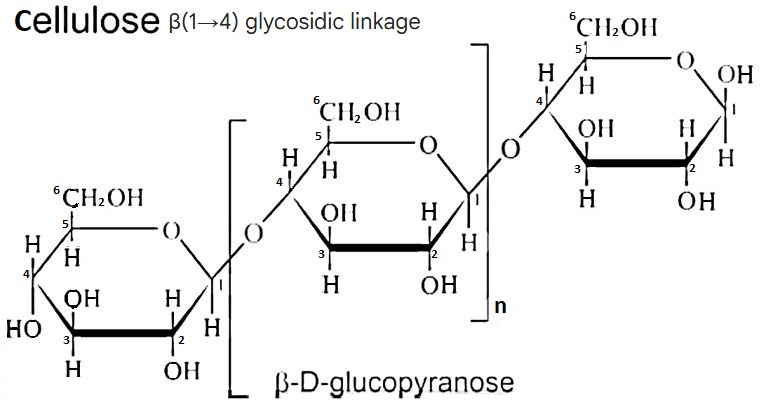
Cellulose
Cellulose is a linear (unbranched) polysaccharide composed exclusively of β-D-glucose units.
The glucose units are connected by β(1→4) glycosidic bonds.
Structure features:
- Long straight chains
- Strong intermolecular hydrogen bonding
- Forms rigid fibers in plant cell walls
Because of this structure, cellulose is insoluble in water and provides structural strength to plants.
Option-wise Explanation
Option 1: Gums
Gums are heteropolysaccharides containing different types of sugars such as arabinose, galactose, and others. They are not composed solely of β-D-glucose units and are not strictly straight chains. Hence this option is incorrect.
Option 2: Starch
Starch is composed of two components:
- Amylose – linear chain with α(1→4) glycosidic bonds
- Amylopectin – branched structure with α(1→4) and α(1→6) bonds
Since starch contains α-D-glucose units, not β-D-glucose, this option is incorrect.
Option 3: Glycogen
Glycogen is a highly branched polysaccharide composed of α-D-glucose units with α(1→4) and α(1→6) linkages. It is not a straight chain polymer. Therefore this option is incorrect.
Option 4: Cellulose
Cellulose is a linear polysaccharide consisting only of β-D-glucose units linked by β(1→4) bonds. Hence it perfectly matches the condition given in the question. Therefore this option is correct.