
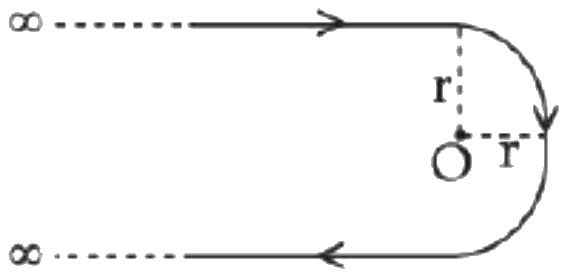
The resultant magnetic field at point O, due to current I in the conductor shown in figure is
Answer & explanation
Correct answer: option 2
The correct answer is Option (2) → \( \vec{B} = \displaystyle\frac{\mu_0 I}{4r}\left[\frac{2}{\pi} + 1\right] \)
The conductor is made of three parts: two semi-infinite straight wires and a semicircular arc of radius \( r \) centred at O. The field at O is the sum of the fields of the three parts.
O lies on the perpendicular through the end of each straight wire, at distance \( r \) from it. The field of a semi-infinite wire at such a point is half that of an infinitely long wire:
\( \displaystyle B_1 = B_2 = \frac{\mu_0 I}{4\pi r} \)
The field at the centre of a semicircular arc is half that of a full circular loop:
\( \displaystyle B_3 = \frac{1}{2}\times\frac{\mu_0 I}{2r} = \frac{\mu_0 I}{4r} \)
By the right-hand rule, the upper wire (current to the right, O below it), the arc (current clockwise about O) and the lower wire (current to the left, O above it) all give a field into the page at O. So the three fields add:
\( \displaystyle B = 2\times\frac{\mu_0 I}{4\pi r} + \frac{\mu_0 I}{4r} = \frac{\mu_0 I}{4r}\left[\frac{2}{\pi} + 1\right] \)