GST: One Nation, One Tax, One Market
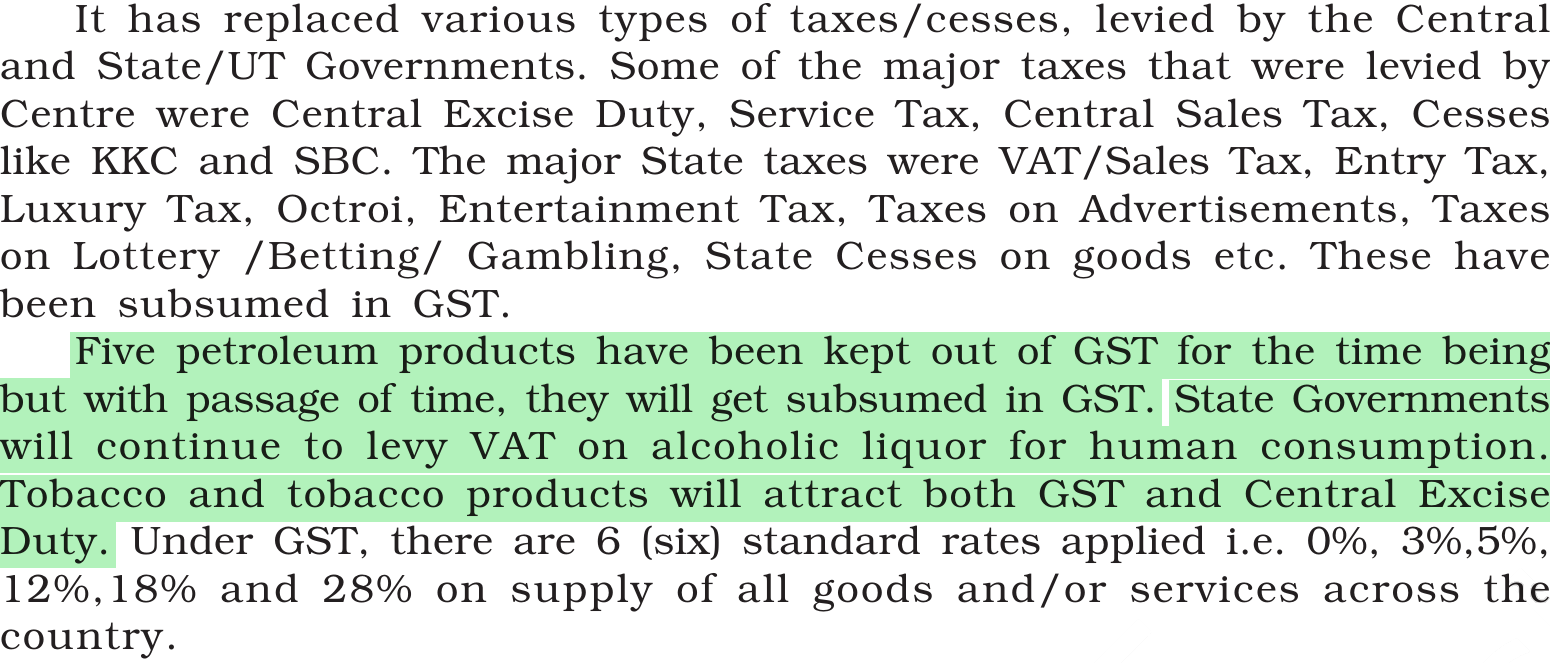
Goods and Service Tax (GST) is the single comprehensive indirect tax, operational from 1 July 2017, on supply of goods and services, right from the manufacturer/ service provider to the consumer. It is a destination based consumption tax with facility of Input Tax Credit in the supply chain. It is applicable throughout the country with one rate for one type of goods/service. It has amalgamated a large number of Central and State taxes and cesses. It has replaced large number of taxes on goods and services levied on production/ sale of goods or provision of service. As there have been a number of intermediate goods/services, which were manufactured/provided in the economy, the pre GST tax regime imposed taxes not on the value added at each stage but on the total value of the commodity/service with minimal facility of utilisation of Input Tax Credit (ITC). The total value included taxes paid on intermediate goods/services. This amounted to cascading of tax. Under GST, the tax is discharged at every stage of supply and the credit of tax paid at the previous stage is available for set off at the next stage of supply of goods and/or services. It is thus effectively a tax on value addition at each stage of supply. In view of our large and fast growing economy, it addresses to establish parity in taxation across the country, and extend principles of 'value-added taxation' to all goods and services. It has replaced various types of taxes/cesses, levied by the Central and State/UT Governments. Some of the major taxes that were levied by Centre were Central Excise Duty, Service Tax, Central Sales Tax, Cesses like KKC and SBC. The major State taxes were VAT/Sales Tax, Entry Tax, Luxury Tax, Octroi, Entertainment Tax, Taxes on Advertisements, Taxes on Lottery /Betting/ Gambling, State Cesses on goods etc. These have been subsumed in GST.
From the following which product has been kept out from the GST ambit?
Answer & explanation
Correct answer: option 4
The correct answer is Option (4) → Tobacco
Note: The given answer is as per the official NTA Answer Key. However, none of the given options appears to be correct: tobacco is taxed under GST, and so are the other three products, as explained below.
When GST came into force on 1 July 2017, it took in most of the indirect taxes of the Centre and the States – excise duty, service tax, VAT, luxury tax, entertainment tax and others – and is levied at one of six standard rates (0, 3, 5, 12, 18 and 28 per cent) on the supply of all goods and services. Only a few items were kept out of the GST ambit:
five petroleum products, kept out for the time being, to be brought into GST later;
alcoholic liquor for human consumption, on which the State Governments continue to levy VAT.
None of the four options is one of these items.
Option (1) Gold — Incorrect. Gold is a good supplied like any other, so it falls under GST; it is not among the items kept out.
Option (2) Silver — Incorrect. For the same reason, silver is taxed under GST and is not kept out.
Option (3) Luxury Consumables. — Incorrect. The State luxury tax is one of the taxes that has been subsumed in GST, so luxury goods are now taxed under GST itself.
Option (4) Tobacco. — Correct as per the NTA answer key; however, it should have been Incorrect. Tobacco and tobacco products attract both GST and Central Excise Duty. The excise duty is charged in addition to GST, not in place of it, so tobacco is inside the GST net.
NCERT (2026-27): Introductory Macroeconomics — Chapter 5: Government Budget and the Economy
|