In substitution nucleophilic bimolecular SN2 reaction, the configuration of the final product involves
Answer & explanation
Correct answer: option 2
The correct answer is Option (2) → inversion of configuration
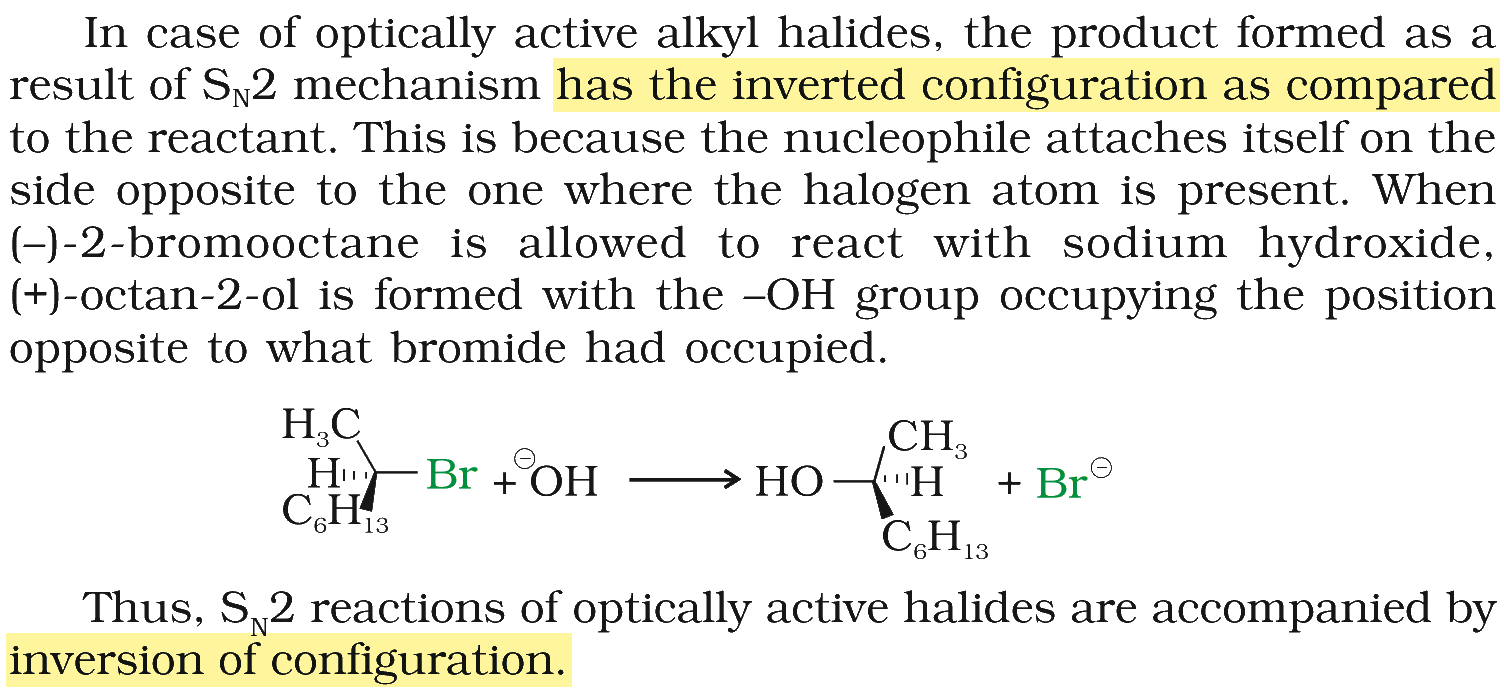
An SN2 reaction takes place in one step. The nucleophile attacks the carbon atom from the side opposite to the leaving group (backside attack):
In the transition state, the carbon is partly bonded to both the incoming nucleophile and the leaving group, and the other three groups lie in one plane.
As the leaving group departs, these three groups flip over to the other side, like an umbrella turning inside out in the wind.
\( \displaystyle \ce{Nu^- + R3C-X -> Nu-CR3 + X^-} \)
So the product of an SN2 reaction always shows inversion of configuration (Walden inversion).
Why the other options are incorrect
Option (1) transition state — Incorrect. The transition state is a stage of the mechanism, not the configuration of the product.
Option (3) retention — Incorrect. Retention would need the nucleophile to attack from the same side as the leaving group, which the leaving group blocks.
Option (4) inversion and retention of configuration — Incorrect. A mixture of inversion and retention (racemisation) is typical of SN1 reactions, where the planar carbocation is attacked from both faces.
NCERT (2026-27 edition):
Reactions of Haloalkanes – …