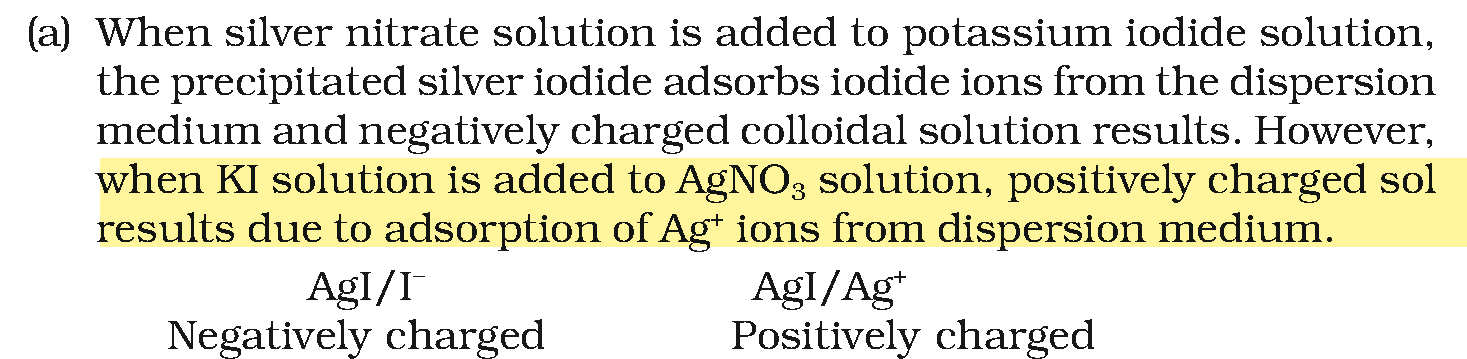
When KI solution is added to AgNO3 solution, then
A. Ag+ ions from dispersion medium get adsorbed on AgI
B. Positively charged sol is formed
C. Negatively charged sol is formed
D. K+ ions of dispersed phase get adsorbed on AgI
Choose the correct answer from the options given below:
Answer & explanation
Correct answer: option 4
The correct answer is Option (4) → A and B only
The charge on a sol comes from preferential adsorption: the precipitate adsorbs the ion common to it that is present in excess in the dispersion medium. When KI solution is added to \( \ce{AgNO3} \) solution, \( \ce{Ag^{+}} \) ions are in excess, so the AgI particles adsorb \( \ce{Ag^{+}} \) and a positively charged sol results:
\( \displaystyle \ce{AgNO3 (excess) + KI -> AgI/Ag+ + KNO3} \)
A. \( \ce{Ag^{+}} \) ions from dispersion medium get adsorbed on AgI — Correct. \( \ce{Ag^+} \) is common to AgI and is present in excess, so it is adsorbed preferentially.
B. Positively charged sol is formed — Correct. AgI/\( \ce{Ag^{+}} \).
C. Negatively charged sol is formed — Incorrect. A negative sol, AgI/\( \ce{I^{-}} \), forms only when \( \ce{AgNO3} \) is added to excess KI.
D. \( \ce{K^{+}} \) ions of dispersed phase get adsorbed on AgI — Incorrect. \( \ce{K^{+}} \) is not a constituent of AgI, so it is not adsorbed preferentially.
Note: This question is from the pre-rationalised NCERT book (2022-23). The topic is not there in the latest NCERT book (2026-27), and it is also out of the CUET 2026 syllabus.
NCERT (Pre-rationalised edition, 2022-23):
Properties of Colloidal Solutions – …