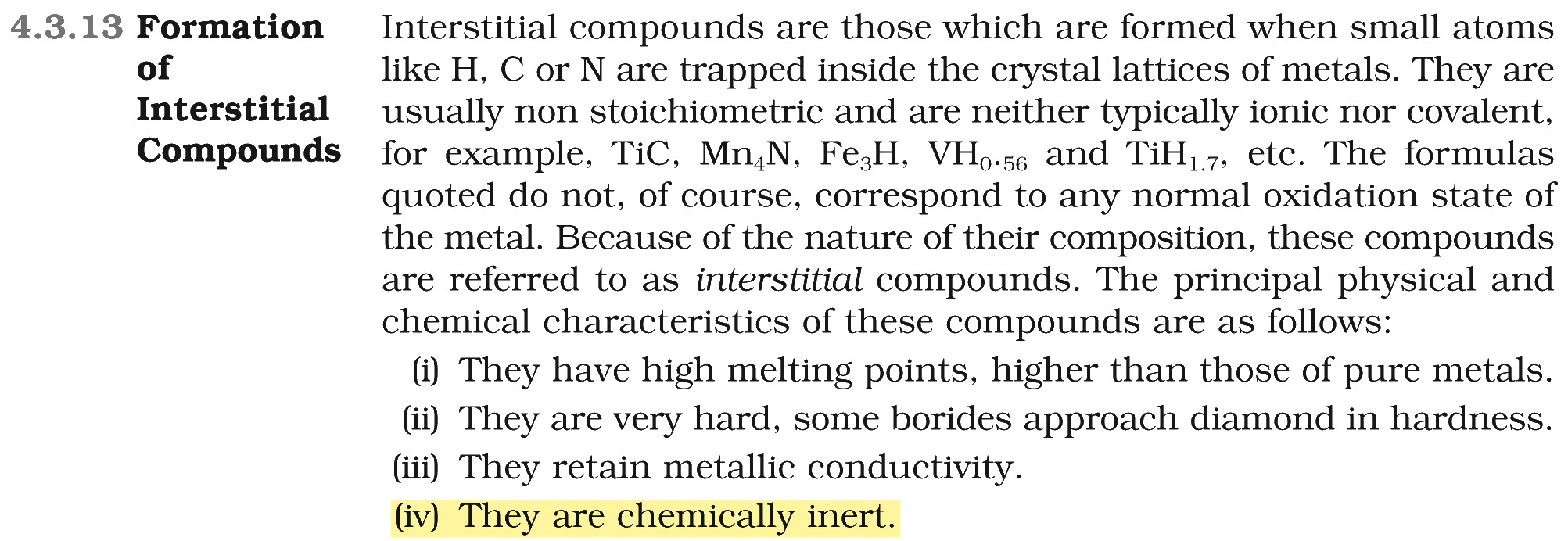
d-Block elements make interstitial compounds with H, C or N trapped inside the crystal lattices of metals. Identify the incorrect property of interstitial compounds from the following:
Answer & explanation
Correct answer: option 4
The correct answer is Option (4) → They are chemically active.
Interstitial compounds form when small atoms such as H, C or N are trapped in the crystal lattice of a transition metal (TiC, \( \ce{Mn4N} \), \( \ce{Fe3H} \)). The small atoms fill the holes of the lattice and make it more rigid.
Option (1) High melting points than pure metals. — A property of interstitial compounds. Their melting points are higher than those of the pure metals.
Option (2) More hard than pure metals. — A property of interstitial compounds. They are very hard; some borides approach diamond in hardness.
Option (3) Retain metallic conductivity — A property of interstitial compounds. The metal lattice is kept, so they still conduct electricity.
Option (4) They are chemically active. — Not a property of interstitial compounds. They are chemically inert.
NCERT (2026-27 edition):
Formation of Interstitial Compounds