Suppose in the long run, the government imposed a tax on the supply of a commodity. How does it affect the equilibrium quantity of commodity?
Answer & explanation
Correct answer: option 1
The correct answer is Option (1) → The quantity of commodity will decrease.
A tax on supply lowers the equilibrium quantity.
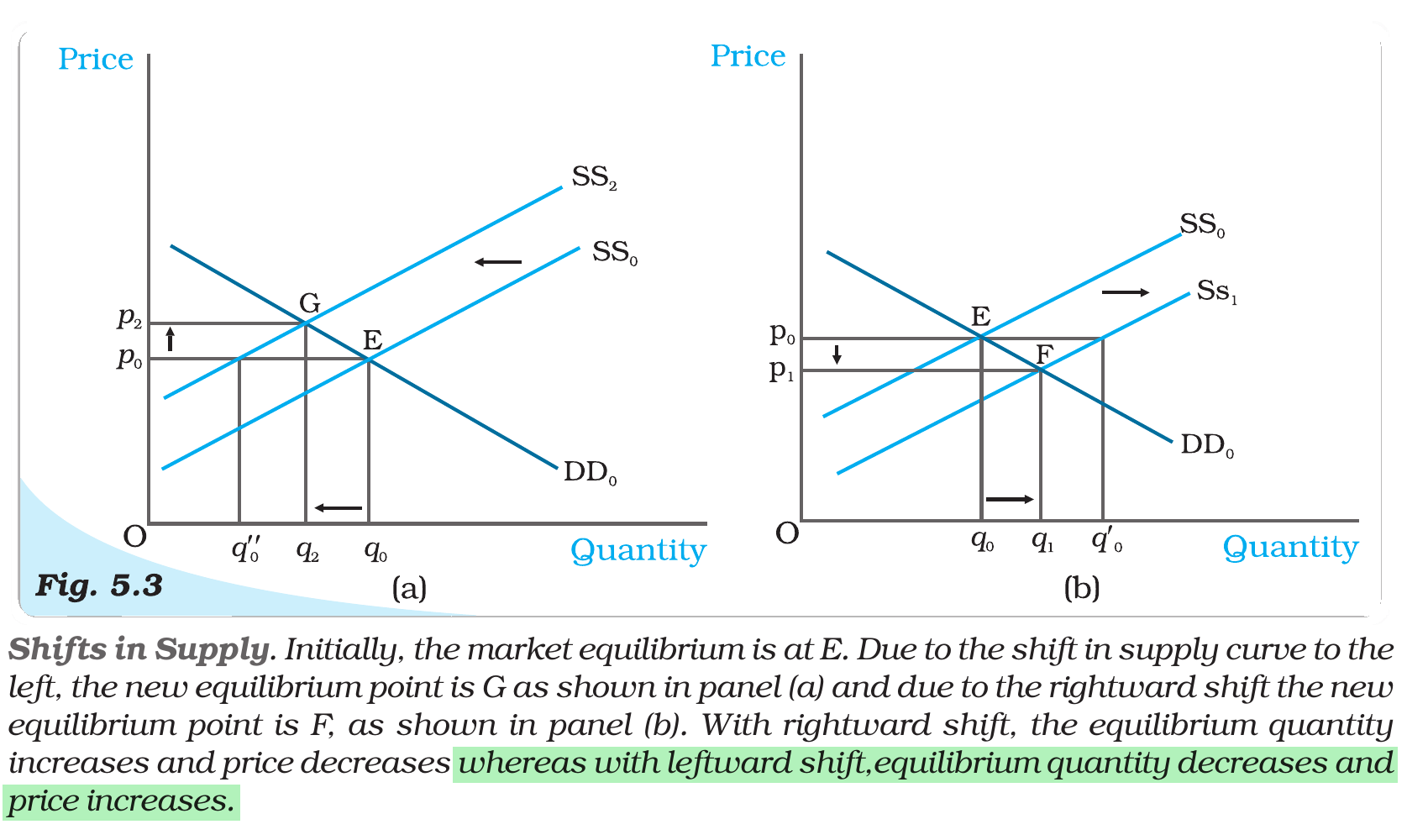
The tax makes each unit costlier for the firm. So at any given market price, the firm supplies fewer units. The supply curve shifts to the left, never to the right.
With demand unchanged, there is now excess demand (buyers want more than firms supply) at the old price, so the price rises. At the new equilibrium, the quantity is lower and the price is higher.
NCERT (2026-27): “Impact of a unit tax on supply A unit tax is a tax that the government imposes per unit sale of output. For example, suppose that the unit tax imposed by the government is Rs 2. Then, if the firm produces and sells 10 units of the good, the total tax that the firm must pay to the government is 10 × Rs 2 = Rs 20.… …Since the firm must pay an extra Rs t for each unit of the good produced, the firm’s long run average cost and long run marginal cost at any level of output increases by Rs t.…Notice that the unit tax shifts the firm’s long run supply curve to the left: at any given market price, the firm now supplies fewer units of output.… Introductory Microeconomics – Chapter 5: Market Equilibrium, Supply Shift …Now, suppose due to some reason, the market supply curve shifts leftward to SS2 with the demand curve remaining unchanged, as shown in panel (a). Because of the shift, at the prevailing price, p0, there will be excess demand equal to q0'' qo in the market. Some consumers who are unable to obtain the good will be willing to pay higher prices and the market price tends to increase. The new equilibrium is attained at point G where the supply curve SS2 intersects the demand curve DD0 such that q2 quantity will be bought and sold at price p2.… Let us consider a situation where all other things remaining constant, there is an increase in the price of an input used in the production of a commodity. This will increase the marginal cost of production of the firms using this input. Therefore, at each price, the market supply will be less than before. Hence, the supply curve shifts leftward. In the Figure 5.3(a), this is shown by a shift in the supply curve from SS0 to SS2. But this increase in input price has no impact on the demand of the consumers since it does not depend on the input prices directly. Therefore, the demand curve remains unchanged. In Figure 5.3(a), this is shown by the demand curve remaining unchanged at DD0. As a result, compared to the old equilibrium, now the market price rises and quantity produced decreases.…” NCERT (2026-27): Introductory Microeconomics — Chapter 5: Market Equilibrium
|