What are the products of the following reaction in neutral solution?
\( MnO_4^{-}+ {S_2O_3}^{2-} + H_2O → ? \)
Answer & explanation
Correct answer: option 3
The correct answer is Option (3) → \(MnO_2, {SO_4}^{2-}, HO^-\)
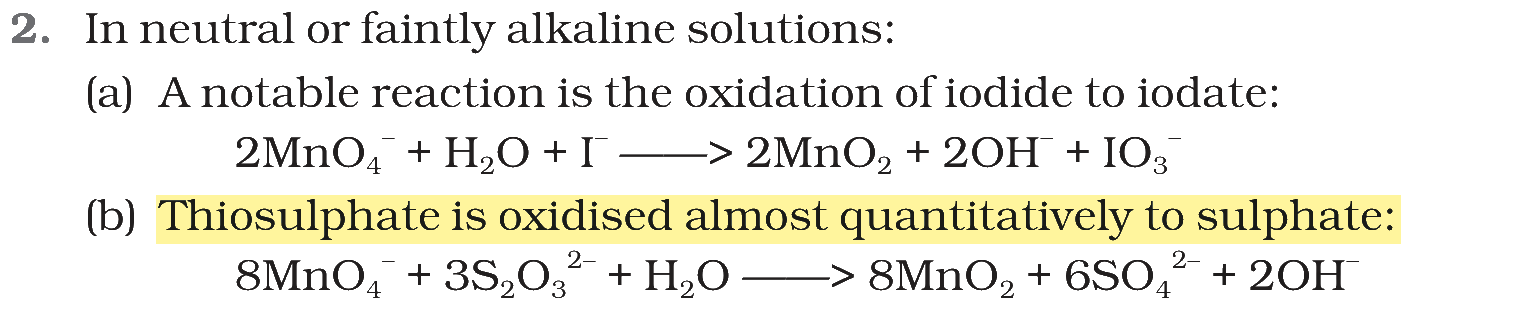
The product of permanganate depends on the medium. In acid it is reduced to \( \ce{Mn^2+} \) (gain of 5 electrons); in neutral or faintly alkaline solution it is reduced only to manganese dioxide (gain of 3 electrons), and hydroxide ions are formed:
\( \displaystyle \ce{MnO4- + 2H2O + 3e^- -> MnO2 + 4OH-} \)
Thiosulphate is oxidised to sulphate. Sulphur goes from +2 in \( \ce{S2O3^2-} \) (2x − 6 = −2) to +6 in \( \ce{SO4^2-} \), so each \( \ce{S2O3^2-} \) loses 8 electrons:
\( \displaystyle \ce{S2O3^2- + 10OH- -> 2SO4^2- + 5H2O + 8e^-} \)
To balance the electrons, the first half-reaction is multiplied by 8 and the second by 3 (24 electrons each). Adding and cancelling water and hydroxide ions:
\( \displaystyle \ce{8MnO4- + 3S2O3^2- + H2O -> 8MnO2 + 6SO4^2- + 2OH-} \)
So the products are \( \ce{MnO2} \), sulphate and hydroxide ions.
Why the other options are incorrect
Option (1) \(MnO_2, {SO_3}^{2-}, H^+\) — Incorrect. Sulphite (S = +4) is not the end product, since permanganate oxidises sulphur fully to +6; and the reaction produces \( \ce{OH-} \), not \( \ce{H+} \).
Option (2) \(MnO_2, SO_2, HO^-\) — Incorrect. \( \ce{SO2} \) is an acidic gas with S = +4; it cannot remain in a solution in which hydroxide ions are formed, and sulphur is oxidised beyond +4.
Option (4) \(Mn^{2+}, {SO_4}^{2-}, H^+\) — Incorrect. \( \ce{Mn^2+} \) is the product in acidic solution: \( \ce{MnO4- + 8H+ + 5e^- -> Mn^2+ + 4H2O} \).
NCERT (2026-27 edition):
In Neutral or Faintly Alkaline Solutions