Rate of Chemical Reaction
Chemical reactions are the simplest way to convert one substance into the other substance. The feasibility of a chemical reaction is decided by the concepts of chemical thermodynamics under a defined set of conditions. The extent of a chemical reaction is determined by the principles of chemical equilibrium. But the information that remains undisclosed is the speed or rate of a chemical reaction, path or mechanism of a chemical reaction, time taken for a reaction to attain a state of equilibrium, factors controlling the rate of reaction etc. This information pertaining to the study of a chemical reaction is very pivotal, and it helps in understanding the nature (slow or fast nature) of a chemical reaction. The kinetics of a chemical reaction can be understood with the help of average rate of reaction or a differential rate law or an integrated rate law. There are various factors on which the rate of a chemical reaction depends viz. nature of reactants, temperature, catalyst, pressure and concentration of reactants and products (rate law expression).
Which of the following expressions correctly represents the rate of the following reaction?
5Br−(aq) + BrO3−(aq) + 6H+(aq) → 3Br2(l) + 3H2O(l)
Answer & explanation
Correct answer: option 1
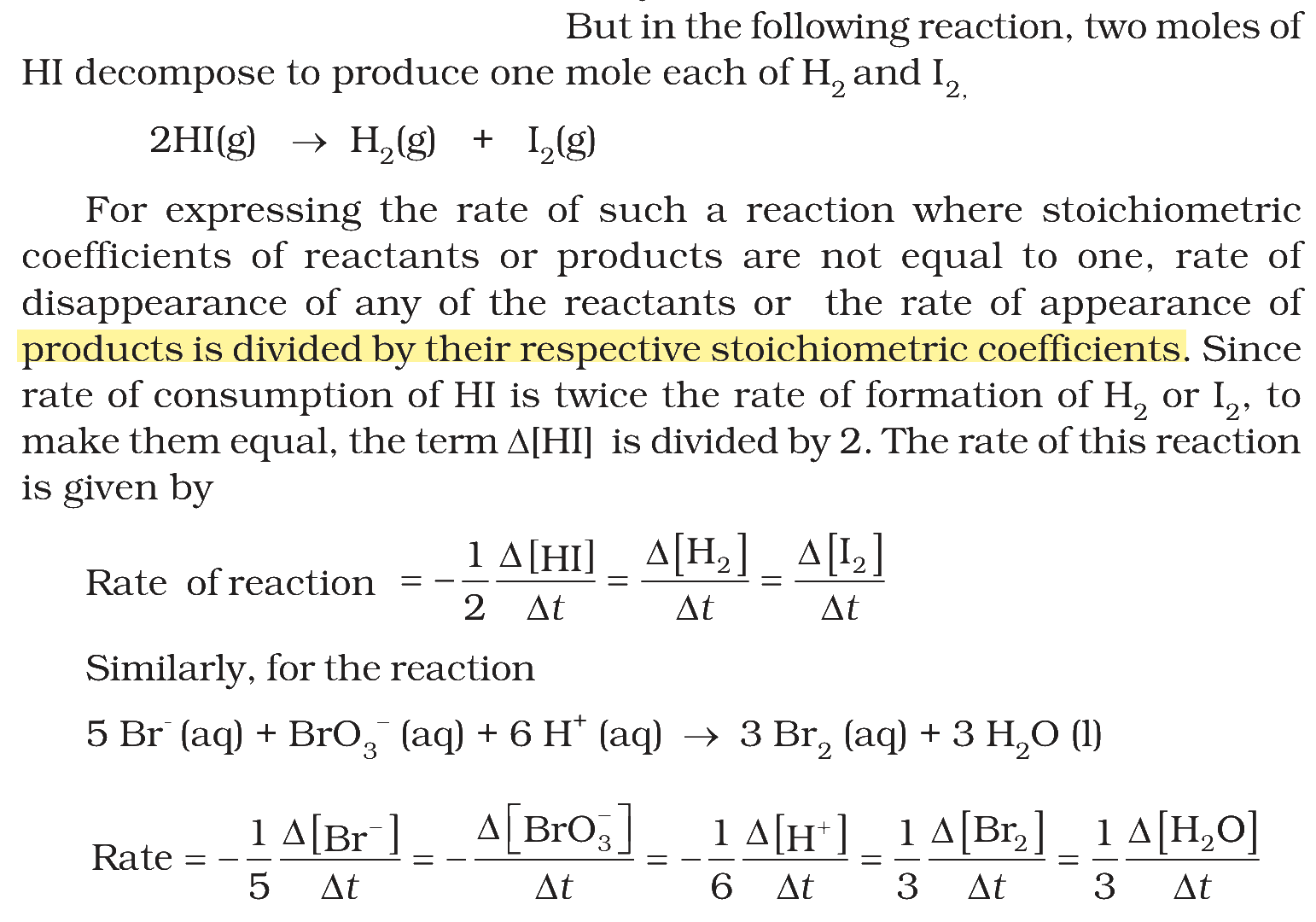
The correct answer is Option (1) → \( \displaystyle \text{Rate}=-\frac{1}{5}\frac{\Delta[Br^-]}{\Delta t}=-\frac{\Delta[BrO_3^-]}{\Delta t}=-\frac{1}{6}\frac{\Delta[H^+]}{\Delta t}=+\frac{1}{3}\frac{\Delta[Br_2]}{\Delta t}=+\frac{1}{3}\frac{\Delta[H_2O]}{\Delta t} \)
The rate of a reaction must have a single value, whichever substance is used to measure it. Two rules make every term equal:
Sign: reactants are used up, so their concentration change is negative and needs a minus sign. Products are formed, so their terms take a plus sign.
Coefficient: each term is divided by the stoichiometric coefficient of that substance.
For a general reaction aA + bB → cC + dD:
\( \displaystyle \text{Rate}=-\frac{1}{a}\frac{\Delta[A]}{\Delta t}=-\frac{1}{b}\frac{\Delta[B]}{\Delta t}=+\frac{1}{c}\frac{\Delta[C]}{\Delta t}=+\frac{1}{d}\frac{\Delta[D]}{\Delta t} \)
In the given reaction, the coefficients are 5 for \( \ce{Br^{-}} \), 1 for \( \ce{BrO3^{-}} \) and 6 for \( \ce{H^{+}} \) (reactants), and 3 for \( \ce{Br2} \) and 3 for \( \ce{H2O} \) (products). So the three reactant terms take a minus sign with 1/5, 1 and 1/6, and the two product terms take a plus sign with 1/3 each. This is Option (1).
Why the other options are incorrect
Option (2) \( \displaystyle \text{Rate}=+\frac{1}{5}\frac{\Delta[Br^-]}{\Delta t}=-\frac{\Delta[BrO_3^-]}{\Delta t}=-\frac{1}{6}\frac{\Delta[H^+]}{\Delta t}=+\frac{1}{3}\frac{\Delta[Br_2]}{\Delta t}=+\frac{1}{3}\frac{\Delta[H_2O]}{\Delta t} \) — Incorrect. \( \ce{Br^{-}} \) is a reactant, and its concentration falls, so its term needs a minus sign.
Option (3) \( \displaystyle \text{Rate}=-\frac{5}{6}\frac{\Delta[Br^-]}{\Delta t}=-\frac{\Delta[BrO_3^-]}{\Delta t}=-\frac{\Delta[H^+]}{\Delta t}=+\frac{\Delta[Br_2]}{3\Delta t}=+\frac{3\Delta[H_2O]}{\Delta t} \) — Incorrect. The coefficients are used wrongly: 5/6 for \( \ce{Br^{-}} \), no 1/6 for \( \ce{H^{+}} \), and the \( \ce{H2O} \) term is multiplied by 3 instead of divided.
Option (4) \( \displaystyle \text{Rate}=-\frac{1}{5}\frac{\Delta[Br^-]}{\Delta t}=-\frac{\Delta[BrO_3^-]}{\Delta t}=-\frac{1}{6}\frac{\Delta[H^+]}{\Delta t}=-\frac{1}{3}\frac{\Delta[Br_2]}{\Delta t}=-\frac{1}{3}\frac{\Delta[H_2O]}{\Delta t} \) — Incorrect. \( \ce{Br2} \) and \( \ce{H2O} \) are products and are being formed, so their terms need a plus sign.
NCERT (2026-27 edition):
Rate of a Chemical Reaction – …