CUETMOCK
  • Pricing
  • Mentors
Log inStart freeStart free mocks→

First test, then trust

Try a free CUET mock test.

Join 5,00,000+ students who rehearsed exam day on the exact NTA screen before sitting CUET. On the web and on Android.

Start free mocks →Get the Android app
CUETMOCK

India's #1 CUET Mock Test Platform. Original NCERT-based questions on the exact NTA exam screen — trusted by 5,00,000+ students since CUET 2022.

Get it onGoogle PlayScan to download the CUETMOCK app

Mock tests

  • CUET mock test series
  • Browse all papers
  • Commerce mocks
  • Humanities (Arts) mocks
  • Science mocks
  • Languages & GAT mocks
  • Free practice questions
  • Pricing

Resources

  • CUET exam guide
  • CUET syllabus
  • Universities accepting CUET
  • Expert blogs
  • News & notifications
  • Webinars & counselling
  • CUET score calculator
  • How we estimate your rank
  • FAQs

Company

  • About us
  • Our leadership & team
  • Our toppers
  • Mentors
  • For schools
  • Contact us
  • Terms
  • Privacy
  • Refund policy

Talk to us

+91 7696 6630 56info@cuetmock.comWhatsApp us

Our other platforms

  • JEE Mock — For IIT-JEE aspirants
  • NEET Mock — For NEET aspirants

Newsletter

Exam updates, study material and offers — no spam.

© 2026 NYC Ventures Pvt. Ltd.

701-702, Royal Business Park, Zirakpur, Punjab - 140603

  • Terms of use
  • Privacy policy
  • Refund policy
  • Contact us

iCUETMOCK is an independent preparation platform, not affiliated with the National Testing Agency (NTA). Always check exam details on the official NTA website.

  • Home
  • Mock tests
  • CUET guide
  • Pricing
  • Log in
Home/Practice questions/History
HistoryModern India: Mahatma Gandhi and the Nationalist movement

Arrange the following Viceroys of British India in a chronological or…

Arrange the following Viceroys of British India in a chronological order:

(A) Lord Mountbatten
(B) Lord Wavell
(C) Lord Linlithgow
(D) Lord Irwin

Choose the correct answer from the options given below:

Answer & explanation+

Correct answer: option 2

The correct answer is Option (2) → (D), (C), (B), (A)

(D) Lord Irwin — the Viceroy at the time of the Salt March of 1930. Gandhiji gave him advance notice of the march, and in 1931 the two signed the Gandhi-Irwin Pact.

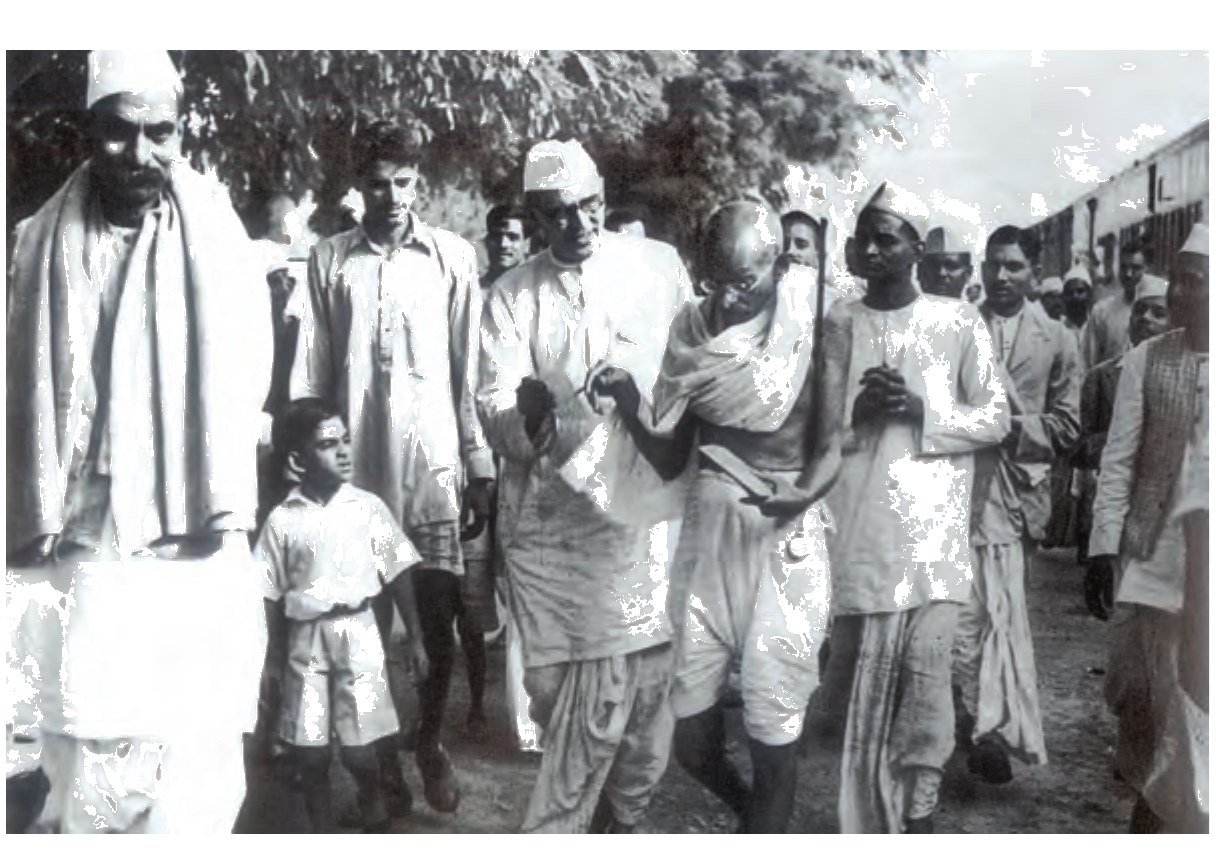
(C) Lord Linlithgow — the Viceroy whom Mahatma Gandhi and Rajendra Prasad met on 13 October 1939 to discuss India’s part in the Second World War.

(B) Lord Wavell — the Viceroy who brought the Congress and the League together for a series of talks in 1945.

(A) Lord Mountbatten — he replaced Wavell as Viceroy in February 1947 and announced that British India would be freed, but also divided.

Note: The NCERT book (2026-27) does not give the years in which each Viceroy held office. The order follows from the dated events with which the book connects each Viceroy: 1930, 1939, 1945 and February 1947.


NCERT (2026-27): “3.1 Dandi … Where most Indians understood the significance of Gandhiji’s challenge, the British Raj apparently did not. Although Gandhiji had given advance notice of his ‘Salt March’ to the Viceroy Lord Irwin, Irwin failed to grasp the significance of the action.…

4. Quit India … In 1945, a Labour government came to power in Britain and committed itself to granting independence to India. Meanwhile, back in India, the Viceroy, Lord Wavell, brought the Congress and the League together for a series of talks.…

4. Quit India … In February 1947, Wavell was replaced as Viceroy by Lord Mountbatten. Mountbatten called one last round of talks, but when these too proved inconclusive he announced that British India would be freed, but also divided.…”

NCERT extract

Fig. 11.10 Mahatma Gandhi and Rajendra Prasad on their way to a meeting with the Viceroy, Lord Linlithgow, 13 October 1939 In the meeting the nature of India’s involvement in the War was discussed. When negotiations with the Viceroy broke down, the Congress ministries resigned.

Advertisement

Practise more on Modern India: Mahatma Gandhi and the Nationalist movement

Chapter-wise mocks on the real NTA exam screen, with solutions and your rank. Your first mocks are free.

Start free mocks →

Advertisement

Next questions

  1. Solve the following. ≤ft((sin 27^°)/(cos 63^°))-≤ft((cos 27^°)/(sin 63^°))^2General Aptitude Test · Quantitative Reasoning
  2. Let f(x)=(sin x)^1/(π-2x), x≠(π)/2. If f (x) is continuous at x=(π)/2, then f((π)/2) isMaths. Section B1 · Continuity and Differentiability
  3. Which among these is NOT the characteristic of Dalit movement ? (1) Evolutionary (2) Revolutionary (3) Reformative (4) RedemptiveSociology · Social Change and Development in India: Social Movements
  4. What does NPT stand for?Political Science · Politics in India Since Independence: India's External Relations
  5. Which of the following statements are correct about Globalisation? (A) Globalisation has occurred in earlier periods in history in differen…Political Science · Contemporary World Politics: Globalisation
  6. If y=x^x , displaystyledy/dx will be:Maths. Section A · Continuity and Differentiability (Section A)
  7. Select the letter-cluster that can replace the question mark (?) in the following series. GHB, LMG, PQK, ?General Aptitude Test · General Ability
  8. Select the most appropriate meaning of the given Idiom:- "To bring up the rear"English · Grammar: Idioms
  9. Select the option in which the words share the same relationship as that shared by the given pair of words. Cat : KittenGeneral Aptitude Test · General Ability
  10. Ujjain, the city of the Simhastha Kumbh Mela, stands on the bank of which river?General Aptitude Test · General Knowledge