
Match List-I with List-II.
| List-I | List-II |
| (i) Oxidation state of Mn in MnO2 | (a) +2 |
| (ii) Most stable oxidation state of Mn | (b) +3 |
| (iii) Highest oxidation state of Mn in its oxides | (c) +4 |
| (iv) Characteristic oxidation state of the lanthanoids | (d) +7 |
Choose the correct answer from the options given below:
Answer & explanation
Correct answer: option 2
The correct answer is Option (2) → (i)-(c), (ii)-(a), (iii)-(d), (iv)-(b)
Manganese (Z = 25) is [Ar]3d54s2; it is in group 7.
(i) Oxidation state of Mn in MnO2 — This matches (c) +4. Charge balance: x + 2(−2) = 0, so x = +4.
(ii) Most stable oxidation state of Mn — This matches (a) +2. Configuration: losing the two 4s electrons gives \( \ce{Mn^2+} \): 3d5, a half-filled d subshell, which is particularly stable.
(iii) Highest oxidation state of Mn in its oxides — This matches (d) +7. Oxide: the highest oxide is \( \ce{Mn2O7} \); charge balance: 2x + 7(−2) = 0, so x = +7, equal to the group number 7.
(iv) Characteristic oxidation state of the lanthanoids — This matches (b) +3. Lanthanoids: the tripositive ions, Ln3+, are the most stable oxidation state of all the lanthanoids.
NCERT (2026-27 edition):
4.3.6 Trends in the M3+/M2+ Standard Electrode Potentials – “… The comparatively high value for Mn shows that Mn2+(d5) is particularly stable, whereas comparatively low value for Fe shows the extra stability of Fe3+ (d5).”
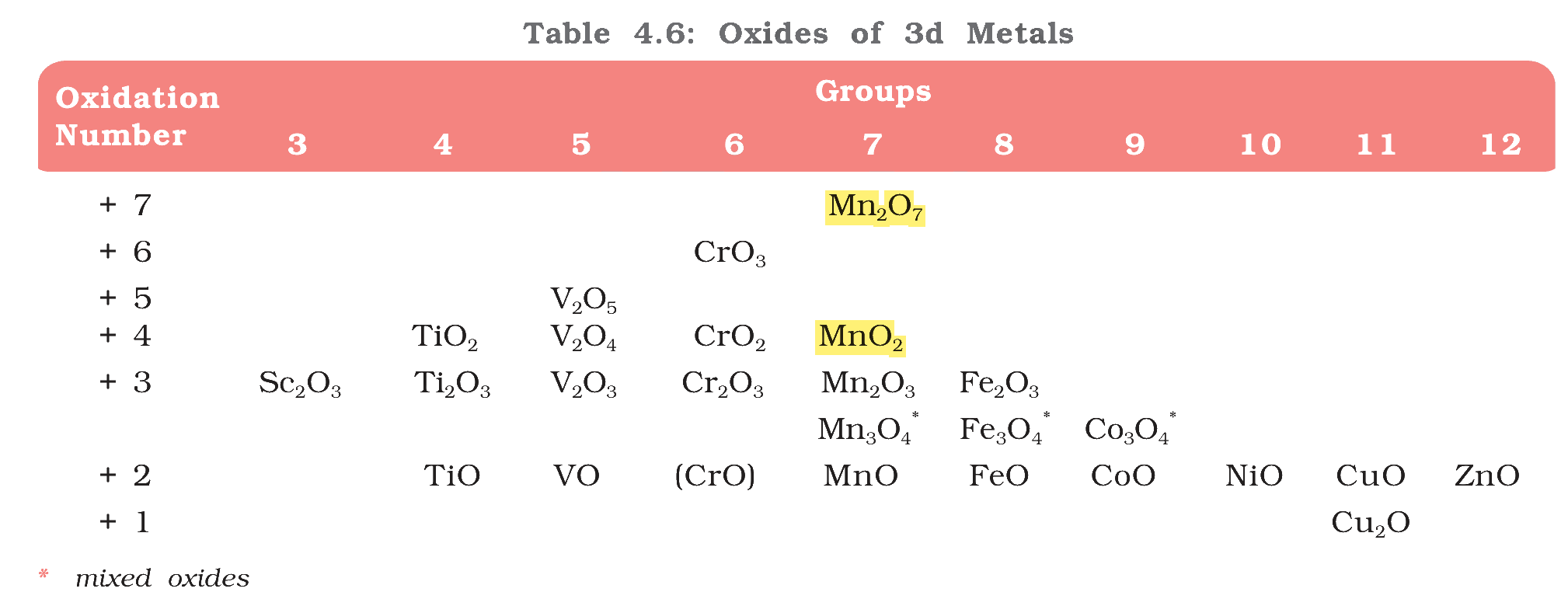
4.3.7 Trends in Stability of Higher Oxidation States – “The ability of oxygen to stabilise the highest oxidation state is demonstrated in the oxides. The highest oxidation number in the oxides (Table 4.6) coincides with the group number and is attained in Sc2O3 to Mn2O7.”
Table 4.6: Oxides of 3d Metals
4.5.1 Electronic Configurations – “… However, the electronic configurations of all the tripositive ions (the most stable oxidation state of all the lanthanoids) are of the form 4fn (n = 1 to 14 with increasing atomic number).”