
Match List I with List II
|
LIST I |
LIST II |
|
A. Eyes |
I. Ginger |
|
B. Rhizome |
II. Potato |
|
C. Offset |
III. Agave |
|
D. Bulbil |
IV. Water hyacinth |
Choose the correct answer from the options given below:
Answer & explanation
Correct answer: option 4
The correct answer is Option (4) → A-II, B-I, C-IV, D-III
|
LIST I |
LIST II |
|
A. Eyes |
II. Potato |
|
B. Rhizome |
I. Ginger |
|
C. Offset |
IV. Water hyacinth |
|
D. Bulbil |
III. Agave |
Vegetative propagules are parts of a plant that can give rise to a new plant without sexual reproduction. In angiosperms, several structures can serve as vegetative propagules. In plants, the units of vegetative propagation such as runner, rhizome, sucker, tuber, offset, bulb are all capable of giving rise to new offspring. These structures are called vegetative propagules. Obviously, since the formation of these structures does not involve two parents, the process involved is asexual. In plants, the term vegetative reproduction is frequently used in place of asexual reproduction. Plants use various vegetative propagule units such as runners of grasses, rhizome of ginger, eyes of potato, offset of water hyacinth and bulbil of agave are all capable of giving rise to new offspring.
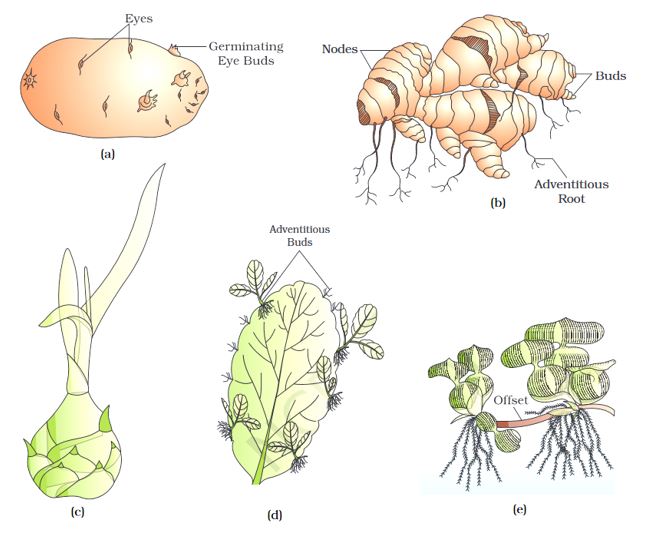
Vegetative propagules in angiosperms: (a) Eyes of potato; (b) Rhizome of ginger;(c) Bulbil of Agave; (d) Leaf buds of Bryophyllum; (e) Offset of water hyacinth