CUETMOCK
  • Pricing
  • Mentors
Log inStart freeStart free mocks→

First test, then trust

Try a free CUET mock test.

Join 5,00,000+ students who rehearsed exam day on the exact NTA screen before sitting CUET. On the web and on Android.

Start free mocks →Get the Android app
CUETMOCK

India's #1 CUET Mock Test Platform. Original NCERT-based questions on the exact NTA exam screen — trusted by 5,00,000+ students since CUET 2022.

Get it onGoogle PlayScan to download the CUETMOCK app

Mock tests

  • CUET mock test series
  • Browse all papers
  • Commerce mocks
  • Humanities (Arts) mocks
  • Science mocks
  • Languages & GAT mocks
  • Free practice questions
  • Pricing

Resources

  • CUET exam guide
  • CUET syllabus
  • Universities accepting CUET
  • Expert blogs
  • News & notifications
  • Webinars & counselling
  • CUET score calculator
  • How we estimate your rank
  • FAQs

Company

  • About us
  • Our leadership & team
  • Our toppers
  • Mentors
  • For schools
  • Contact us
  • Terms
  • Privacy
  • Refund policy

Talk to us

+91 7696 6630 56info@cuetmock.comWhatsApp us

Our other platforms

  • JEE Mock — For IIT-JEE aspirants
  • NEET Mock — For NEET aspirants

Newsletter

Exam updates, study material and offers — no spam.

© 2026 NYC Ventures Pvt. Ltd.

701-702, Royal Business Park, Zirakpur, Punjab - 140603

  • Terms of use
  • Privacy policy
  • Refund policy
  • Contact us

iCUETMOCK is an independent preparation platform, not affiliated with the National Testing Agency (NTA). Always check exam details on the official NTA website.

  • Home
  • Mock tests
  • CUET guide
  • Pricing
  • Log in
Home/Practice questions/Economics
EconomicsMacro Economics: Open Economy Macro Economics

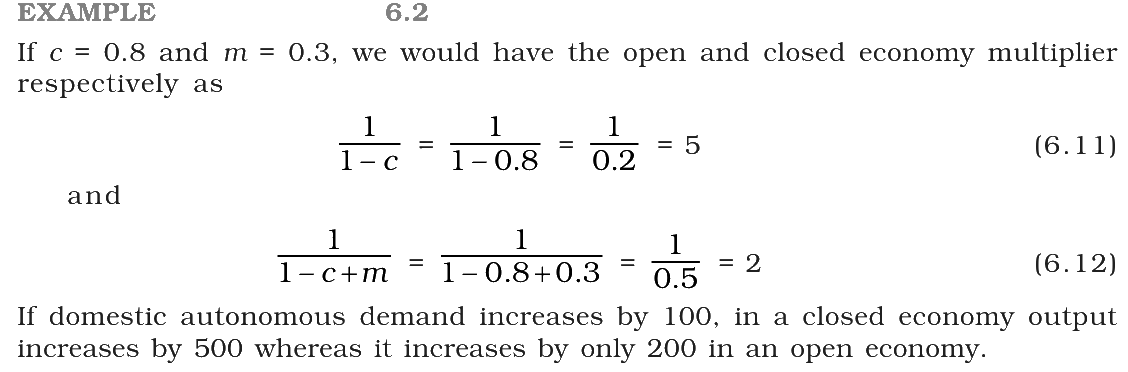
If c = 0.8 and m = 0.3, calculate open economy multiplier.

If c = 0.8 and m = 0.3, calculate open economy multiplier.

Answer & explanation+

Correct answer: option 3

The correct answer is Option (3) → 2

Given:

Marginal propensity to consume, c = 0.8

Marginal propensity to import, m = 0.3

In an open economy part of every extra rupee goes on imports, so m enters the multiplier.

\( \displaystyle \text{Open economy multiplier} = \frac{1}{1 - c + m} \)

\( \displaystyle = \frac{1}{1 - 0.8 + 0.3} = \frac{1}{0.5} = 2 \)

Option (1) 5 — this leaves out m: 1/(1 − 0.8) = 5 is the closed economy multiplier.

NCERT (2026-27):
NCERT extract

NCERT extract

Advertisement

Practise more on Macro Economics: Open Economy Macro Economics

Chapter-wise mocks on the real NTA exam screen, with solutions and your rank. Your first mocks are free.

Start free mocks →

Advertisement

Next questions

  1. Light from a point source in air falls on spherical glass surface (n = 1.4 and radius of curvature 20 cm). The distance of light source fro…Physics · Ray Optics
  2. Suppose the grant in the second panel created an agrahara. Which of the following would follow for the grantee?History · Ancient India: Kings, Farmers and Towns
  3. What is the major concern/fear of critics of globalisation in 'political terms'?Political Science · Contemporary World Politics: Globalisation
  4. Select the option that is related to the fourth number in the same way a the first number is related to the second number and the fifth num…General Aptitude Test · General Ability
  5. Assertion(A) - A new venture should begin with a strong management team committed to the goals of the enterprise. Reason(R): The organisati…Entrepreneurship · Entrepreneurial Planning
  6. "It is a tempestuous river running down mountain gorges" Here the word "tempestuous" is used asEnglish · Comprehension - (Narrative / Factual)
  7. In which year did Nandalal Bose join Kala Bhavana?Fine Arts · The Modern Indian Art
  8. If the papers of 4 students can be checked by any one of the 7 teachers, then the probability that all the 4papers are checked by exactly 2…Maths. Section B1 · Probability
  9. Which of the following can prevent the decomposition of H2O2?Chemistry · Physical: Surface Chemistry
  10. Which of the following statements is true?Statement I: The institutional structure of rural banking consists of moneylenders and traders.St…Economics · Indian Economic Development: Rural Development