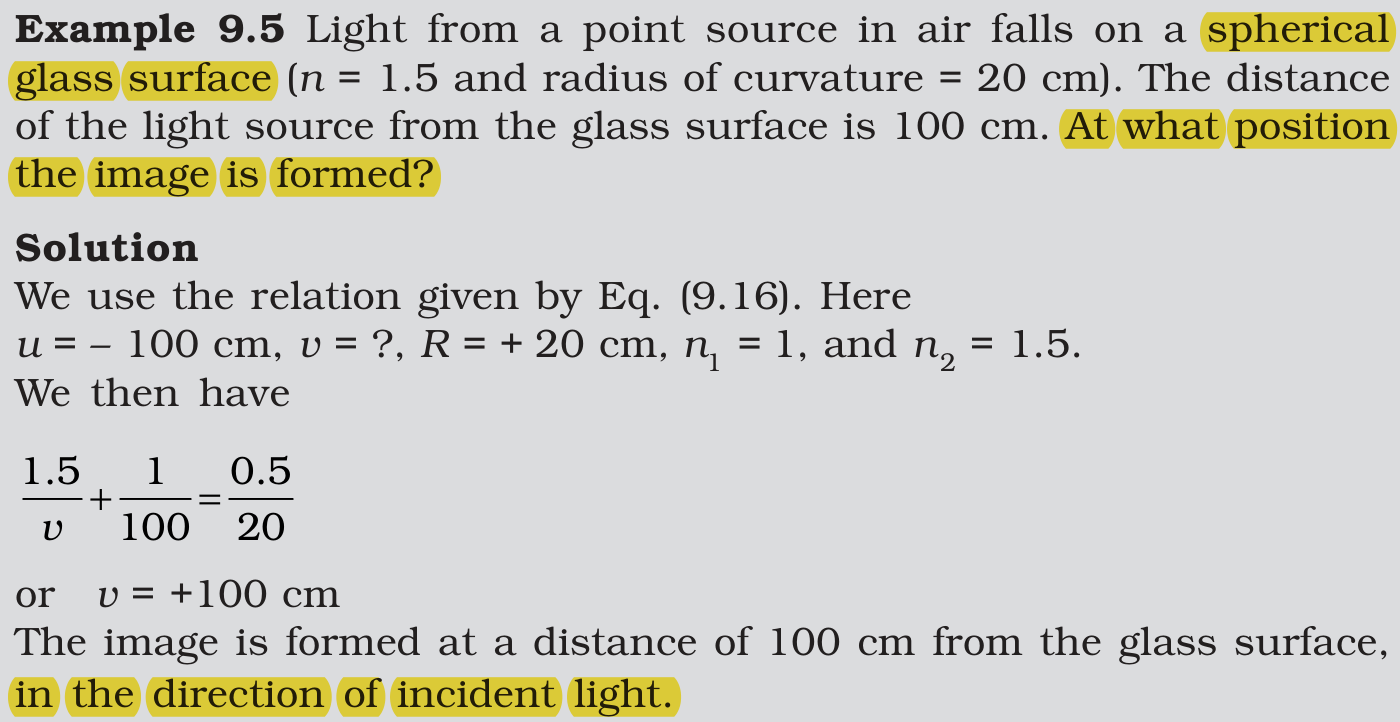
Light from a point source in air falls on spherical glass surface (n = 1.4 and radius of curvature 20 cm). The distance of light source from the glass surface is 150 cm. At what position is the image formed?
Answer & explanation
Correct answer: option 2
The correct answer is Option (2) → 105 cm from glass surface in the direction of incident light
For refraction at a spherical surface from a medium of index \( n_1 \) into a medium of index \( n_2 \),
\( \displaystyle \frac{n_2}{v} - \frac{n_1}{u} = \frac{n_2 - n_1}{R} \)
Using the Cartesian sign convention, with distances measured from the surface and positive in the direction of the incident light, and taking the surface convex towards the source (centre of curvature in the glass):
\( n_1 = 1, \ n_2 = 1.4 \)
\( u = -150\,\mathrm{cm} \)
\( R = +20\,\mathrm{cm} \)
\( \displaystyle \frac{1.4}{v} - \frac{1}{-150} = \frac{1.4 - 1}{20} \)
\( \displaystyle \frac{1.4}{v} = 0.02 - 0.00667 = 0.01333 \)
\( \displaystyle v = \frac{1.4}{0.01333} = +105\,\mathrm{cm} \)
The positive sign means a real image inside the glass, 105 cm from the surface in the direction of the incident light.
Note: NTA picked this question from an NCERT (2026-27) example and changed the figures. Do not ignore NCERT while practising numericals.
NCERT (2026-27):
Refraction at a Spherical Surface – …