Match List-I with List-II
| List I | List II |
 |
 |
 |
 |
 |
 |
 |
 |
Choose the correct answer from the options given below:
Answer & explanation
Correct answer: option 1
The correct answer is Option (1) → (A)-(IV), (B)-(I), (C)-(II), (D)-(III)
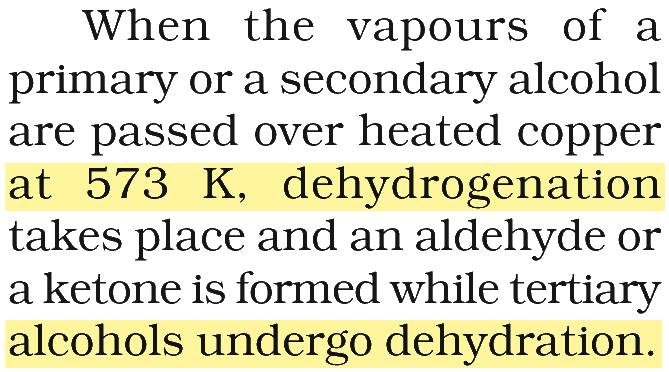
When the vapours of an alcohol are passed over heated copper at 573 K, primary and secondary alcohols are dehydrogenated (to an aldehyde and a ketone), while tertiary alcohols, which have no H on the carbinol carbon, undergo dehydration to an alkene. Acidified \( \ce{KMnO4} \) is a strong oxidant and takes a primary alcohol to the carboxylic acid.
(A) RCH2OH, Cu/573 K — This matches (IV) RCHO. A primary alcohol loses hydrogen to give an aldehyde.
\( \ce{RCH2OH} \xrightarrow{\text{Cu, 573 K}} \ce{RCHO + H2} \)
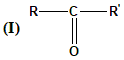
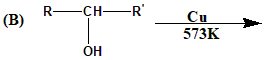
(B) R–CH(OH)–R′, Cu/573 K — This matches (I) R–CO–R′. A secondary alcohol loses hydrogen to give a ketone.
\( \ce{RCH(OH)R^{\prime}} \xrightarrow{\text{Cu, 573 K}} \ce{RCOR^{\prime} + H2} \)
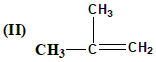
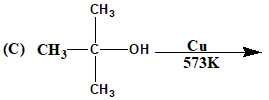
(C) (CH3)3C–OH, Cu/573 K — This matches (II) CH3–C(CH3)=CH2. The tertiary alcohol has no H on the carbinol carbon, so it loses water instead and gives 2-methylpropene.
\( \ce{(CH3)3C-OH} \xrightarrow{\text{Cu, 573 K}} \ce{(CH3)2C=CH2 + H2O} \)
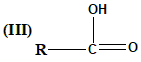
(D) RCH2OH, KMnO4/H+ — This matches (III) RCOOH. Strong oxidation of a primary alcohol goes past the aldehyde to the carboxylic acid.
\( \ce{RCH2OH} \xrightarrow{\ce{KMnO4/H+}} \ce{RCOOH} \)
NCERT (2026-27 edition):
Oxidation – …