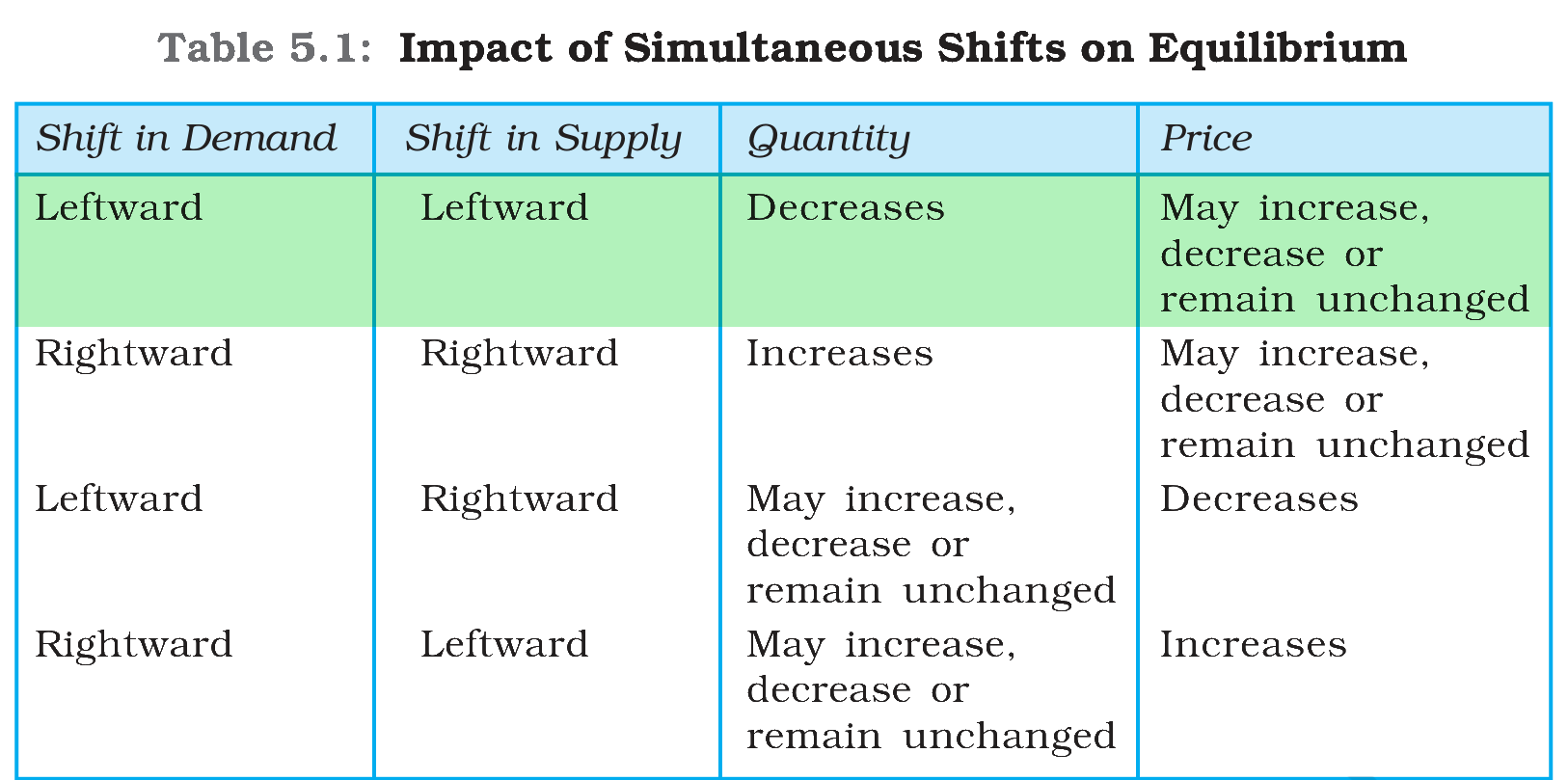
Which of the following statement/statements are true?
Statement I: When decrease in demand is equal to decrease in supply, equilibrium quantity decreases.
Statement II: When decrease in demand is equal to decrease in supply, price increases and quantity decreases.
Answer & explanation
Correct answer: option 3
The correct answer is Option (3) → Statement I is true and Statement II is false.
When demand and supply both shift left, less is bought and sold. What happens to the price depends on the size of the two shifts.
Statement I: When decrease in demand is equal to decrease in supply, equilibrium quantity decreases. — True. Both curves move left, so the equilibrium quantity falls whatever the size of the shifts.
Statement II: When decrease in demand is equal to decrease in supply, price increases and quantity decreases. — False. At the old price, demand and supply each fall by the same amount, so they are still equal there. The price stays the same; only the quantity falls.
Note: NTA uses the terms ‘decrease in demand’ and ‘decrease in supply’; NCERT describes these as leftward shifts of the demand curve and the supply curve.
NCERT (2026-27): “Simultaneous Shifts of Demand and Supply … In the first two cases which are shown in the first two rows of the table, the impact on equilibrium quantity is unambiguous but the equilibrium price may change, if at all, in either direction depending on the magnitudes of shifts. In the next two cases, shown in the last two rows of the table, the effect on price is unambiguous whereas effect on quantity depends on the magnitude of shifts in the two curves.”
|