The following statements trace Mughal painting from Akbar to Shah Jahan. Consider the following statements:
(A) Workshops and artists from Iran produced a harmonious blend of Indo-Iranian styles, especially early on.
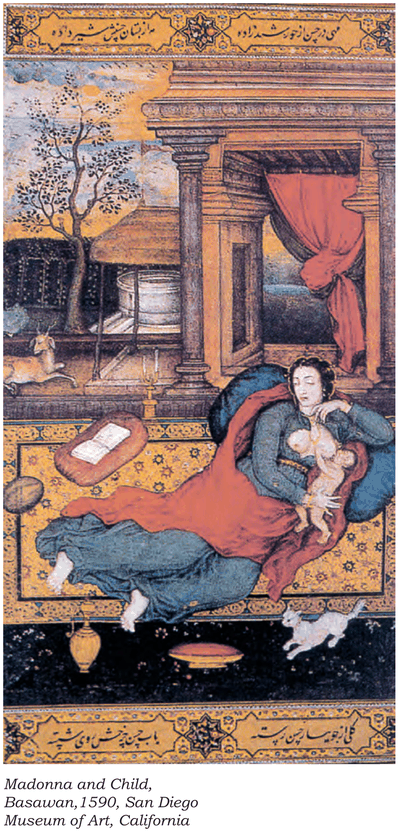
(B) Madonna and Child, an early work of the Mughal School, was painted by Basawan.
(C) Under Shah Jahan, naturalistic rendering and accurate depiction were preferred over idealisation and great stylisation.
(D) Under Shah Jahan, the artworks used jewel-like colours, perfect rendering and intricate fine lines.
Choose the correct answer from the options given below:
Answer & explanation
Correct answer: option 3
The correct answer is Option (3) → (A), (B) and (D) only
A. Workshops and artists from Iran produced a harmonious blend of Indo-Iranian styles, especially early on. — Correct. Workshops in the Mughal courts and artists from Iran gave a harmonious blend of Indo-Iranian styles.
B. Madonna and Child, an early work of the Mughal School, was painted by Basawan. — Correct. The caption under the painting names Basawan as its painter.
C. Under Shah Jahan, naturalistic rendering and accurate depiction were preferred over idealisation and great stylisation. — Incorrect. The order is reversed. Under Shah Jahan, idealisation and great stylisation were preferred over naturalistic rendering.
D. Under Shah Jahan, the artworks used jewel-like colours, perfect rendering and intricate fine lines. — Correct. Shah Jahan’s artworks gained their exalted beauty from jewel-like colours, perfect rendering and fine lines.
Note: This topic was not named in the CUET 2026 syllabus, but it was part of the NCERT chapter. In 2025 and 2026, NTA also asked questions on topics in NCERT that the CUET syllabus did not name. So our mocks have questions from every part of the NCERT chapter, to give you enough practice. Read the whole chapter, not only the sub-topics named in the syllabus.
NCERT (2026-27): “Influences on Mughal Painting …In the Mughal courts, arts became more formalised as there were workshops and many artists were brought from Iran, which resulted in a harmonious blend of Indo-Iranian styles, especially during its early years. This celebrated eminence in Mughal art was possible only due to its distinctive character of assimilating and engaging artists of both Indian and Iranian origins, who contributed towards making, and further elevating the artistic paradigm of the Mughal style.”
“…The son of Jahangir, Prince Khurram, succeeded the throne of Delhi by the name Shah Jahan (1628–1658). With this, he not only acquired a politically stable empire but also the finest of artist and atelier. Shah Jahan encouraged the artists in the atelier to create magnificent works that were a blend of imagination and documentation. Idealisation and great stylisation were preferred over naturalistic rendering and accurate depiction. The artworks produced under his supervision concentrated on subliminal qualities and exalted beautification, which was created by the use of jewel-like colours, perfect rendering and intricate fine lines.” |