
CUETMOCK
  • Pricing
  • Mentors
Log inStart freeStart free mocks→

First test, then trust

Try a free CUET mock test.

Join 5,00,000+ students who rehearsed exam day on the exact NTA screen before sitting CUET. On the web and on Android.

Start free mocks →Get the Android app
CUETMOCK

India's #1 CUET Mock Test Platform. Original NCERT-based questions on the exact NTA exam screen — trusted by 5,00,000+ students since CUET 2022.

Get it onGoogle PlayScan to download the CUETMOCK app

Mock tests

  • CUET mock test series
  • Browse all papers
  • Commerce mocks
  • Humanities (Arts) mocks
  • Science mocks
  • Languages & GAT mocks
  • Free practice questions
  • Pricing

Resources

  • CUET exam guide
  • CUET syllabus
  • Universities accepting CUET
  • Expert blogs
  • News & notifications
  • Webinars & counselling
  • CUET score calculator
  • How we estimate your rank
  • FAQs

Company

  • About us
  • Our leadership & team
  • Our toppers
  • Mentors
  • For schools
  • Contact us
  • Terms
  • Privacy
  • Refund policy

Talk to us

+91 7696 6630 56info@cuetmock.comWhatsApp us

Our other platforms

  • JEE Mock — For IIT-JEE aspirants
  • NEET Mock — For NEET aspirants

Newsletter

Exam updates, study material and offers — no spam.

© 2026 NYC Ventures Pvt. Ltd.

701-702, Royal Business Park, Zirakpur, Punjab - 140603

  • Terms of use
  • Privacy policy
  • Refund policy
  • Contact us

iCUETMOCK is an independent preparation platform, not affiliated with the National Testing Agency (NTA). Always check exam details on the official NTA website.

  • Home
  • Mock tests
  • CUET guide
  • Pricing
  • Log in
Home/Practice questions/Chemistry
ChemistryOrganic: Aldehydes, Ketones and Carboxylic Acids

Identify the final major product [Q] in the following reactions.
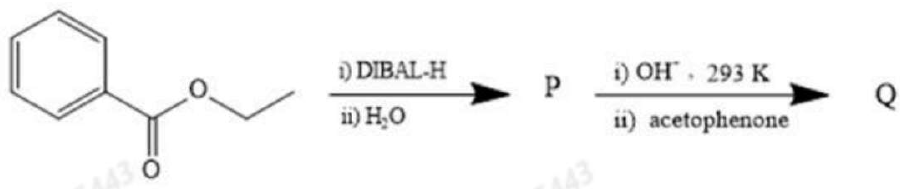
Identify the final major product [Q] in the following reactions.

Figure for Q20

Answer & explanation+

Correct answer: option 2

The correct answer is Option (2) → 1,3-diphenylprop-2-en-1-one (chalcone)

Two reactions are used here.

(i) DIBAL-H reduction of an ester. Diisobutylaluminium hydride is a mild, bulky reducing agent. At low temperature it reduces an ester only as far as the aldehyde. So ethyl benzoate gives benzaldehyde, P:

    \( \displaystyle \ce{C6H5COOC2H5} \xrightarrow[\text{(ii) }\ce{H2O}]{\text{(i) DIBAL-H}} \ce{C6H5CHO + C2H5OH} \)

(ii) Claisen–Schmidt (cross aldol) condensation. Benzaldehyde has no α-hydrogen, so it cannot form an enolate and acts only as the carbonyl acceptor. The base removes an α-hydrogen from acetophenone, and the carbanion adds to the C=O of benzaldehyde. The β-hydroxy ketone formed loses water at once, because the new C=C is conjugated with both the ring and the C=O group:

    \( \displaystyle \ce{C6H5CHO + CH3COC6H5} \xrightarrow[\text{293 K}]{\ce{OH^-}} \ce{C6H5CH=CHCOC6H5 + H2O} \)

So Q is 1,3-diphenylprop-2-en-1-one (benzalacetophenone, or chalcone).

Why the other options are incorrect

  • Option (1) 1,3-diphenylprop-2-en-1-ol — Incorrect. This alcohol would need the C=O group to be reduced (for example by \( \ce{NaBH4} \)); a base does not reduce it.

  • Option (3) 1,3-diphenylpropene — Incorrect. It has no oxygen at all. Removing the C=O group completely needs a Clemmensen or Wolff–Kishner reduction.

  • Option (4) 2-hydroxy-1,3-diphenylpropan-1-one — Incorrect. Its –OH is on the α-carbon. An aldol product has the –OH on the β-carbon, and here it dehydrates anyway.

NCERT (2026-27 edition):
Preparation of Aldehydes – “… Alternatively, nitriles are selectively reduced by diisobutylaluminium hydride, (DIBAL-H) to imines followed by hydrolysis to aldehydes: … Similarly, esters are also reduced to aldehydes with DIBAL-H.”

Cross Aldol Condensation – …
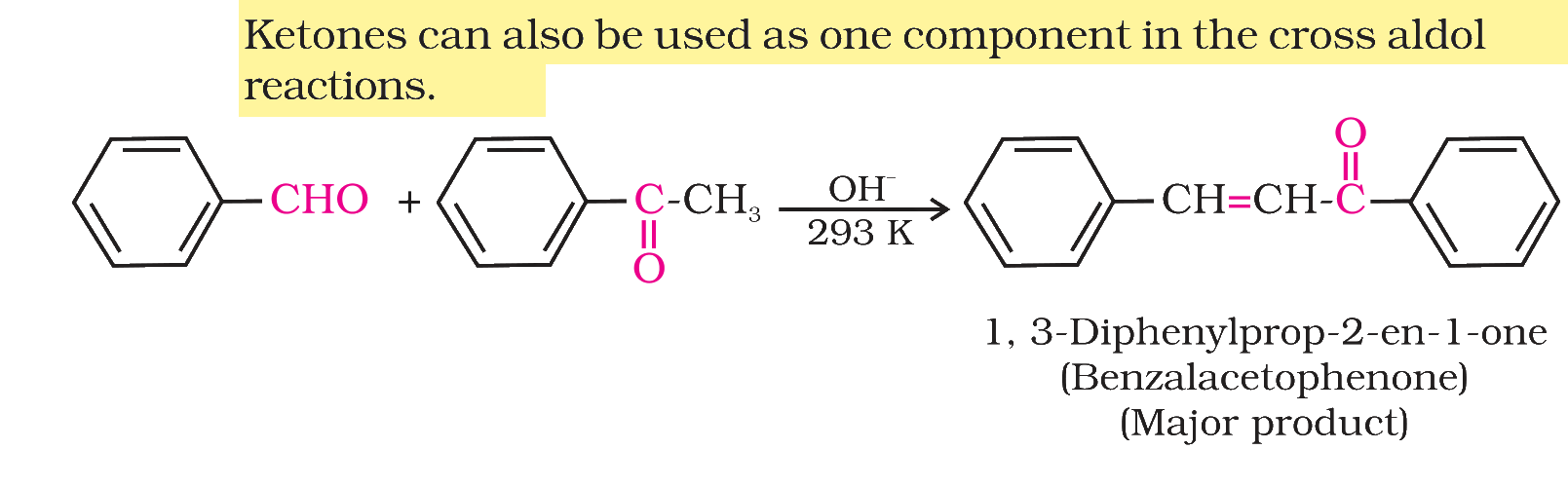
Textbook extract

Advertisement

Practise more on Organic: Aldehydes, Ketones and Carboxylic Acids

Chapter-wise mocks on the real NTA exam screen, with solutions and your rank. Your first mocks are free.

Start free mocks →

Advertisement

Next questions

  1. A man starts from his house and walked for 10 m towards North and turned left and walked 25 m he then turned right and walked 5 m and again…General Aptitude Test · Verbal Reasoning
  2. The following table shows the number of cars of 6 different brands on the roads during a given year. Brand Cars B1 2000 B2 2200 B3 2700 B4…General Aptitude Test · Quantitative Reasoning
  3. Assertion (A): The New Economic Policy (NEP) introduced in 1991 included both stabilisation measures and structural reform measures. Reason…Economics · Indian Economic Development: Liberalisation, Privatisation and Globalisation - An Appraisal
  4. The ratio between the speed of two trains is 3 : 5, if the first train covers 450 kms. in 3 hours, then the speed of the second train is?General Aptitude Test · Numerical Ability
  5. The Kabini, which rises in the Wayanad hills of Kerala, is a tributary of which river?General Aptitude Test · General Knowledge
  6. गद्यांश में लेखक ने इनमें से किस कवि को 'प्रेम की पीर' के सच्चे गायक में सम्मिलित नहीं किया है ?Hindi · Comprehension - (Narrative / Factual)
  7. Which of the following ports are linked to the sea through a river or canal ?Geography · Fundamentals of Human Geography: International Trade
  8. Match List-I with List-II.List-IList-II(A) Period after 1810(I) Temporary revenue settlements were made(B) Revenue demand fixed under the P…History · Modern India: Colonialism and the Countryside
  9. Objective function of an LPP represents:Applied Maths. Section B2 · Linear Programming
  10. What is the meaning of the idiom "spick and span"?English · Grammar: Idioms