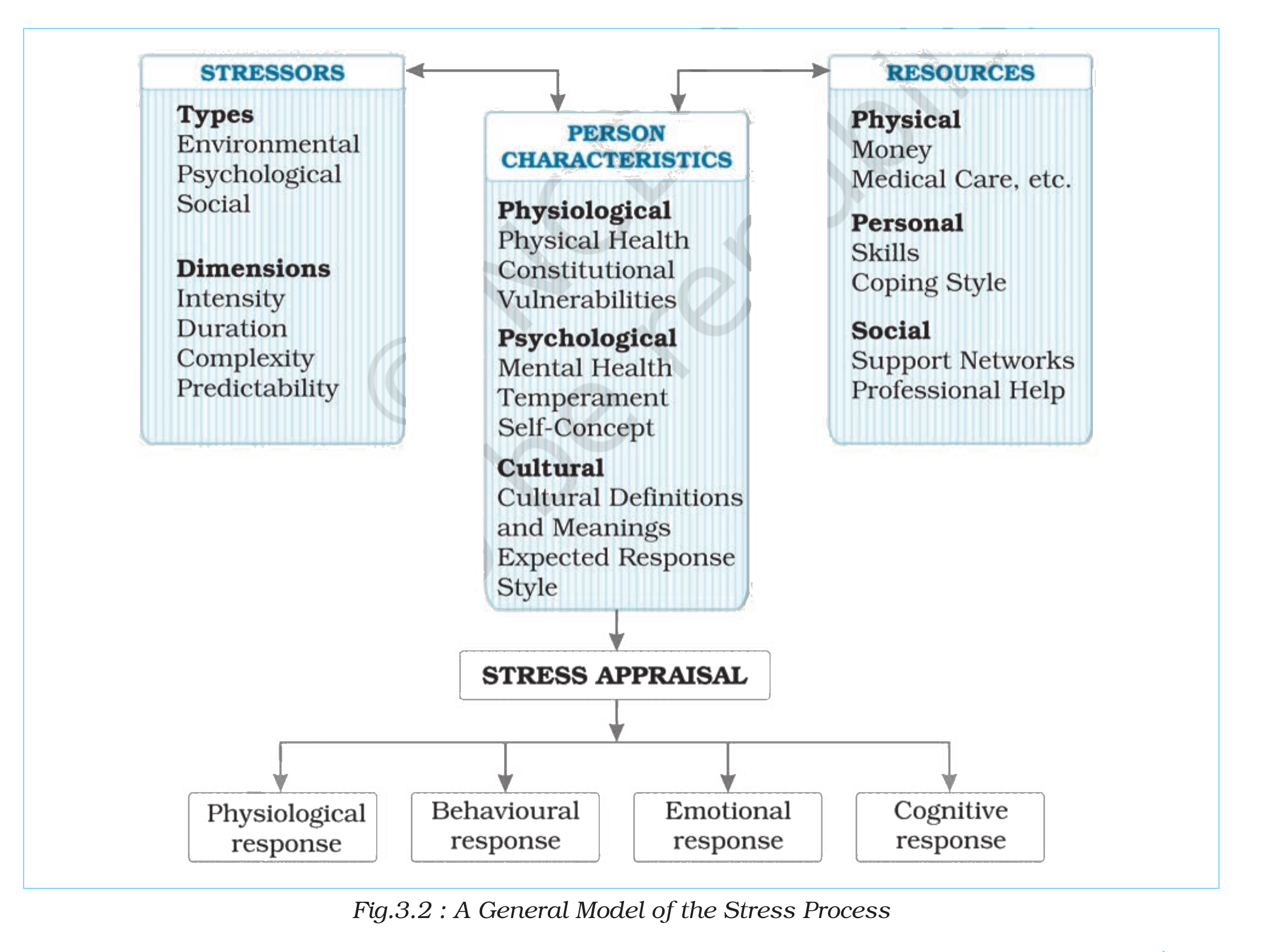
Arrange Lazarus Model of Stress in sequence.
(A) Secondary appraisals involve assessment of one's coping resource
(B) We are likely to make secondary appraisals once we perceive any event as stressful
(C) An individual's response to a stressful situation largely depends upon the perceived events and how they are appraised
(D) Hence this two level appraisal process determines our cognitive, behavioural and emotional responses to external events.
(E) Primary appraisal is done to perceive changing environment as positive, negative or neutral in its consequences
Choose the correct answer from the options given below:
Answer & explanation
Correct answer: option 1
The correct answer is Option (1) → (C), (E), (B), (A), (D)
(C) An individual’s response to a stressful situation largely depends upon the perceived events and how they are appraised — the starting point of Lazarus’ cognitive theory: stress depends on how the event is perceived and appraised.
(E) Primary appraisal is done to perceive changing environment as positive, negative or neutral in its consequences — the first level of appraisal; negative events are appraised further for their possible harm, threat or challenge.
(B) We are likely to make secondary appraisals once we perceive any event as stressful — the second level follows only after an event has been perceived as stressful in primary appraisal.
(A) Secondary appraisals involve assessment of one’s coping resource — what secondary appraisal does: it assesses one’s coping abilities and resources, mental, physical, personal or social, and whether they will be enough to meet the harm, threat or challenge.
(D) Hence this two level appraisal process determines our cognitive, behavioural and emotional responses to external events. — the result of both levels; the word ‘Hence’ shows it comes last.
NCERT (2025-26): “Nature of Stress … The perception of stress is dependent upon the individual’s cognitive appraisal of events and the resources available to deal with them. The stress process, based on the cognitive theory of stress propounded by Lazarus and his colleagues, is described in Figure 3.2. An individual’s response to a stressful situation largely depends upon the perceived events and how they are interpreted or appraised. Lazarus has distinguished between two types of appraisal, i.e. primary and secondary. Primary appraisal refers to the perception of a new or changing environment as positive, neutral or negative in its consequences. Negative events are appraised for their possible harm, threat or challenge. Harm is the assessment of the damage that has already been done by an event. Threat is the assessment of possible future damage that may be brought about by the event. Challenge appraisals are associated with more confident expectations of the ability to cope with the stressful event, the potential to overcome and even profit from the event. When we perceive an event as stressful, we are likely to make a secondary appraisal, which is the assessment of one’s coping abilities and resources and whether they will be sufficient to meet the harm, threat or challenge of the event. These resources may be mental, physical, personal or social. If one thinks one has a positive attitude, health, skills and social support to deal with the crises s/he will feel less stressed. This two-level appraisal process determines not only our cognitive and behavioural responses but also our emotional and physiological responses to external events.…”
|