
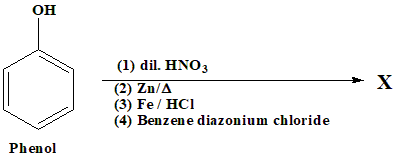
Identify 'X' from the following.
Answer & explanation
Correct answer: option 4
The correct answer is Option (4) → p-Aminoazobenzene, C6H5–N=N–C6H4–NH2(p)
The sequence turns phenol into aniline and then couples it with a diazonium salt. First, dilute nitric acid at room temperature nitrates phenol to o- and p-nitrophenol:
\( \displaystyle \ce{C6H5OH} \xrightarrow[\text{298 K}]{\text{dil. }\ce{HNO3}} \ce{O2NC6H4OH}\ (o\text{- and } p\text{-}) \)
Next, heating with zinc dust removes the phenolic –OH (as zinc dust converts phenol to benzene), leaving nitrobenzene:
\( \displaystyle \ce{O2NC6H4OH + Zn} \xrightarrow{\Delta} \ce{C6H5NO2 + ZnO} \)
Then Fe/HCl reduces the nitro group to give aniline:
\( \displaystyle \ce{C6H5NO2 + 6[H]} \xrightarrow{\ce{Fe/HCl}} \ce{C6H5NH2 + 2H2O} \)
Finally, benzenediazonium chloride couples with aniline at its para position in mildly acidic medium, an electrophilic substitution:
\( \displaystyle \ce{C6H5N2^+Cl^- + C6H5NH2} \xrightarrow{\text{pH 4-5}} \ce{C6H5-N=N-C6H4-NH2 + HCl} \)
X is p-aminoazobenzene (aniline yellow), a yellow azo dye.
Why the other options are incorrect
Option (1) azobenzene, C6H5N=NC6H5 — Incorrect. The coupling partner aniline keeps its –\( \ce{NH2} \) group in the product.
Option (2) o-nitroazobenzene — Incorrect. The nitro group has already been reduced to –\( \ce{NH2} \) by Fe/HCl, and coupling takes place at the para position.
Option (3) p-nitroazobenzene — Incorrect. Again the nitro group would have to survive the Fe/HCl reduction, which it does not.
NCERT (2026-27 edition):
Reactions Involving Retention of Diazo Group – “… The azo products obtained have an extended conjugate system having both the aromatic rings joined through the –N=N– bond. These compounds are often coloured and are used as dyes. Benzene diazonium chloride reacts with phenol in which the phenol molecule at its para position is coupled with the diazonium salt to form p-hydroxyazobenzene. This type of reaction is known as coupling reaction. Similarly the reaction of diazonium salt with aniline yields p-aminoazobenzene. This is an example of electrophilic substitution reaction.”