The reaction of cyclohexanecarbaldehyde with semicarbazide hydrochloride in presence of weak acid gives
Answer & explanation
Correct answer: option 1
The correct answer is Option (1) → cyclohexanecarbaldehyde semicarbazone
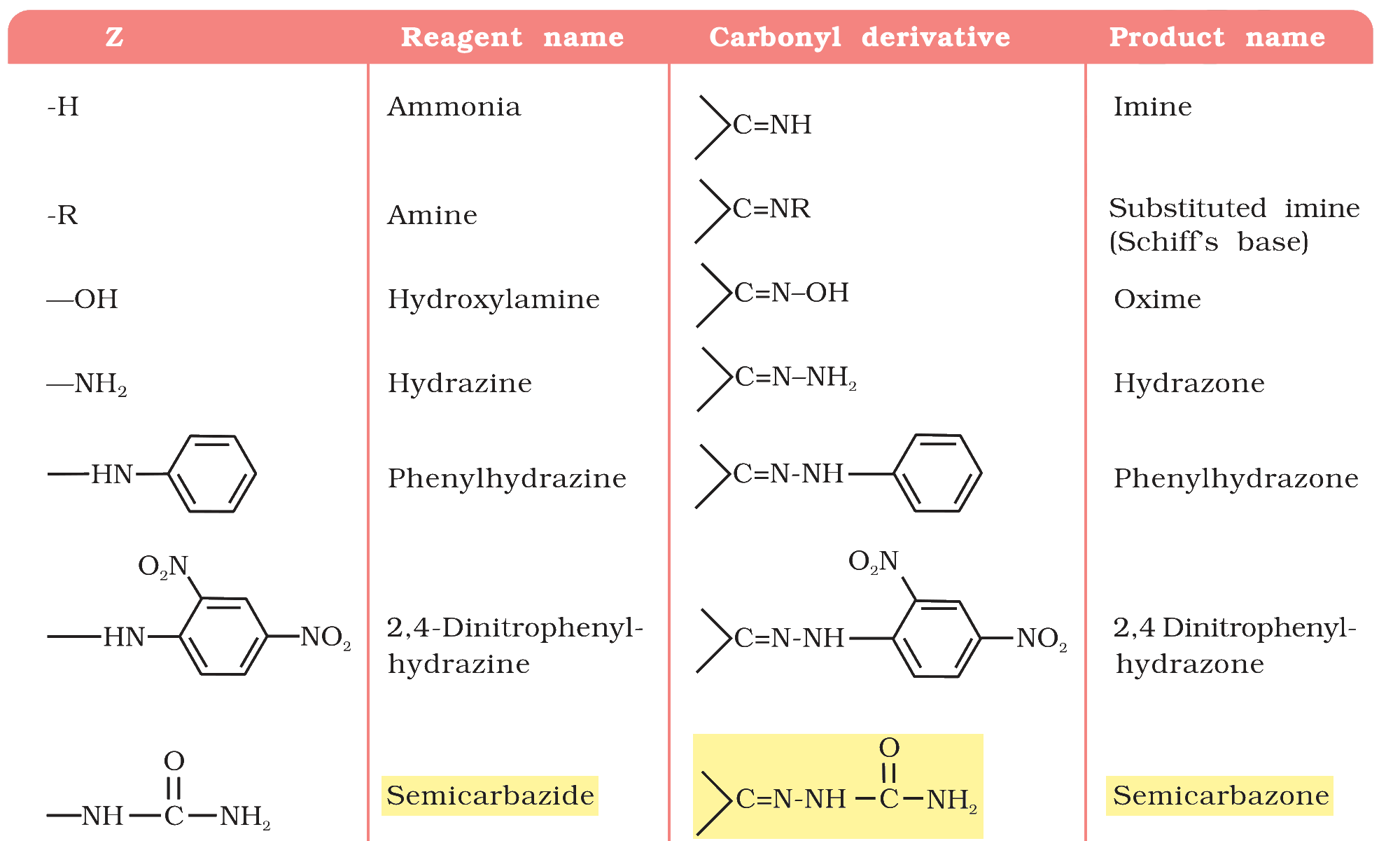
Aldehydes and ketones react with ammonia derivatives (Z–NH2) in a nucleophilic addition–elimination: the \( \ce{NH2} \) group adds to the C=O carbon and a molecule of water is lost, giving a C=N–Z product. The reaction needs a weakly acidic medium, which protonates the C=O oxygen but leaves the nitrogen free to attack.
\( \displaystyle \ce{R2C=O + H2N-Z -> R2C=N-Z + H2O} \)
Semicarbazide is \( \ce{H2N-NH-CO-NH2} \). Its two \( \ce{NH2} \) groups are not alike:
The \( \ce{NH2} \) next to the C=O group is amide-like; its lone pair is delocalised into the carbonyl group, so it is not nucleophilic.
The \( \ce{NH2} \) attached to the –NH– (hydrazine end) keeps its lone pair free, so this nitrogen attacks the carbonyl carbon.
With cyclohexanecarbaldehyde (\( \ce{C6H11-CHO} \)), the aldehyde carbon becomes the C=N carbon:
\( \displaystyle \ce{C6H11-CHO + H2N-NH-CO-NH2} \xrightarrow{\ce{H^+}} \ce{C6H11-CH=N-NH-CO-NH2 + H2O} \)
This is structure 1: the ring carries a CH=N group, joined to NH–CO–NH2.
Why the other options are incorrect
Option (2) cyclohexanone semicarbazone — Incorrect. Here the ring carbon itself is the C=N carbon, so the product would come from cyclohexanone; the aldehyde carbon (CH) is missing.
Option (3) CH=N bonded to the carbonyl carbon — Incorrect. This would require the amide-like \( \ce{NH2} \) to attack, which it does not do; the C=N nitrogen must be bonded to NH, not to C=O.
Option (4) cyclohexylidene bonded to the carbonyl side — Incorrect. It is again a cyclohexanone derivative, and it is linked through the wrong (amide) nitrogen.
NCERT (2026-27 edition):
Addition of Ammonia and Its Derivatives – …