
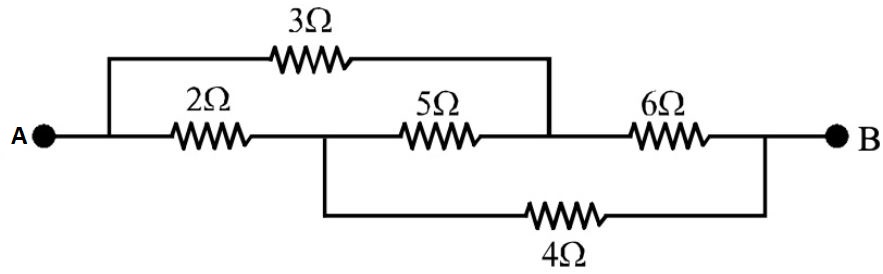
In the circuit shown, a potential difference is applied between A and B. The equivalent resistance between A and B is
Answer & explanation
Correct answer: option 3
The correct answer is Option (3) → \( 3.6\,\Omega \)
The network is a Wheatstone bridge. When the ratios of the resistances in its two arms are equal, the bridge is balanced. The two ends of the middle resistor are then at the same potential, and no current flows through it.
From the figure, call the junction after the \( 2\,\Omega \) resistor D and the junction where the \( 3\,\Omega \) and \( 5\,\Omega \) resistors meet C:
One arm runs A → D → B through \( 2\,\Omega \) and \( 4\,\Omega \).
The other arm runs A → C → B through \( 3\,\Omega \) and \( 6\,\Omega \).
The \( 5\,\Omega \) resistor joins D and C.
The balance condition holds:
\( \displaystyle \frac{2\,\Omega}{4\,\Omega}=\frac{3\,\Omega}{6\,\Omega} \)
So D and C are at the same potential, and the \( 5\,\Omega \) resistor carries no current. Hence it can be removed. Two series paths in parallel are left:
\( 2\,\Omega+4\,\Omega=6\,\Omega \)
\( 3\,\Omega+6\,\Omega=9\,\Omega \)
\( \begin{aligned} R_{AB} &= \frac{6\times9}{6+9}\,\Omega \\ &= \frac{54}{15}\,\Omega \\ &= 3.6\,\Omega \end{aligned} \)