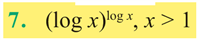
If \( y=(\log_e x)^{\log_e x} \), then \( \displaystyle\frac{dy}{dx} \) is equal to:
Answer & explanation
Correct answer: option 4
The correct answer is Option (4) → \( (\log_e x)^{\log_e x}\left[\displaystyle\frac{1+\log_e(\log_e x)}{x}\right] \)
Both the base and the power contain x, so we take logarithms (logarithmic differentiation).
\( \displaystyle \log_e y=\log_e x\cdot\log_e(\log_e x) \)
Differentiating with the product rule and the chain rule:
\( \displaystyle \frac{1}{y}\frac{dy}{dx}=\frac{1}{x}\log_e(\log_e x)+\log_e x\cdot\frac{1}{\log_e x}\cdot\frac{1}{x} \)
\( \displaystyle \frac{1}{y}\frac{dy}{dx}=\frac{1+\log_e(\log_e x)}{x} \)
\( \displaystyle \frac{dy}{dx}=(\log_e x)^{\log_e x}\left[\frac{1+\log_e(\log_e x)}{x}\right] \)
Why the other options are incorrect
Option (1) \( \log_e x\,(\log_e x)^{\log_e x-1}\,\displaystyle\frac{1}{x} \) — Incorrect. This treats the power \( \log_e x \) as a constant and uses the power rule; it misses the term that comes from differentiating the power.
Option (2) \( \displaystyle\frac{1}{(\log_e x)^{\log_e x}}\left[\frac{1+\log_e(\log_e x)}{x}\right] \) — Incorrect. This divides by y instead of multiplying: \( \frac{1}{y}\frac{dy}{dx} \) equals the bracket, so \( \frac{dy}{dx} \) is y times the bracket.
Option (3) \( \left(\displaystyle\frac{1}{x}\right)^{1/x} \) — Incorrect. At x = e this equals \( e^{-1/e} \), while the correct derivative at x = e is \( \frac{1}{e} \).
NCERT (2026-27 edition):
Logarithmic Differentiation