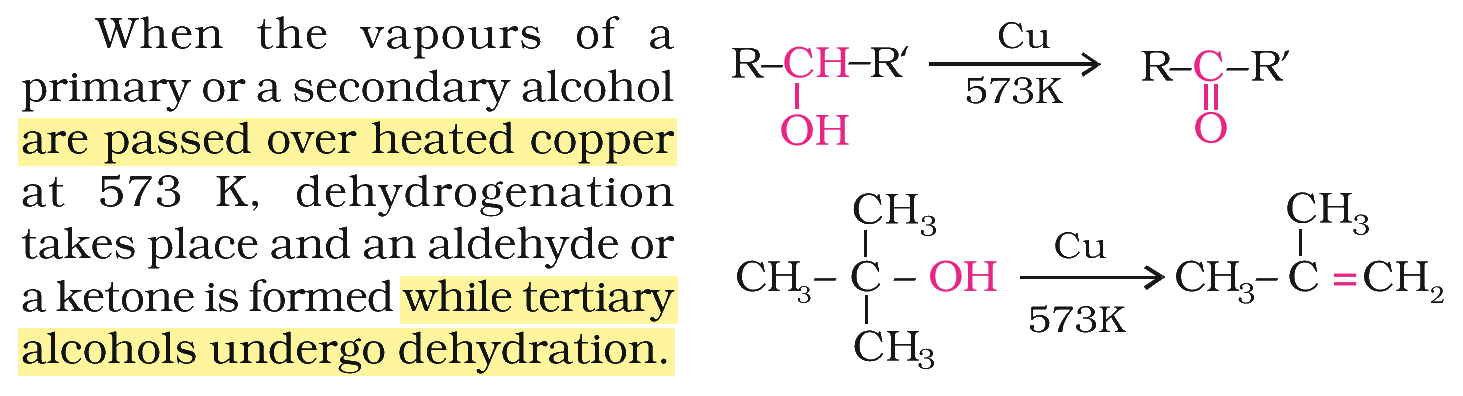
When the vapors of a secondary alcohol and a tertiary alcohol are passed over heated copper at 573 K, separately, a secondary alcohol undergoes reaction A and forms the product X, while a tertiary alcohol undergoes reaction B and forms the product Y .
Identify the reactions A and B and the products X and Y in the above reactions.
Answer & explanation
Correct answer: option 2
The correct answer is Option (2) → A-dehydrogenation,X-ketone ; B-dehydration , Y-alkene
When the vapours of an alcohol are passed over heated copper at 573 K, the result depends on whether the carbon carrying –OH has a hydrogen atom:
A tertiary alcohol has no hydrogen on the carbon carrying –OH, so it cannot be dehydrogenated and is dehydrated instead:
\( \displaystyle \ce{CH3-CH(OH)-CH3} \xrightarrow{\ce{Cu},\ 573\ \mathrm{K}} \ce{CH3-CO-CH3 + H2} \)
\( \displaystyle \ce{(CH3)3C-OH} \xrightarrow{\ce{Cu},\ 573\ \mathrm{K}} \ce{(CH3)2C=CH2 + H2O} \)
So reaction A is dehydrogenation giving X = ketone, and reaction B is dehydration giving Y = alkene.
Why the other options are incorrect
Option (1) A- dehydrogenation, X-aldehyde ; B-dehydration, Y-alkane — Incorrect. An aldehyde comes from a primary alcohol, and dehydration removes water to form a C=C bond, so it gives an alkene, not an alkane.
Option (3) A-dehydration , X-aldehyde ; B-dehydrogenation,Y-ketone — Incorrect. The reactions are swapped; a tertiary alcohol has no H on the carbinol carbon and cannot form a ketone.
Option (4) A-dehydration, X-ketone; B-dehydrogenation, Y-aldehyde — Incorrect. Dehydration cannot give a ketone, and a tertiary alcohol cannot give an aldehyde.
NCERT (2026-27 edition):
Dehydrogenation – …