Match List-I with List-II
| List-I | List-II |
| (A) Short run Marginal Cost (SMC) | (I) \( ΔTC/Δq \) |
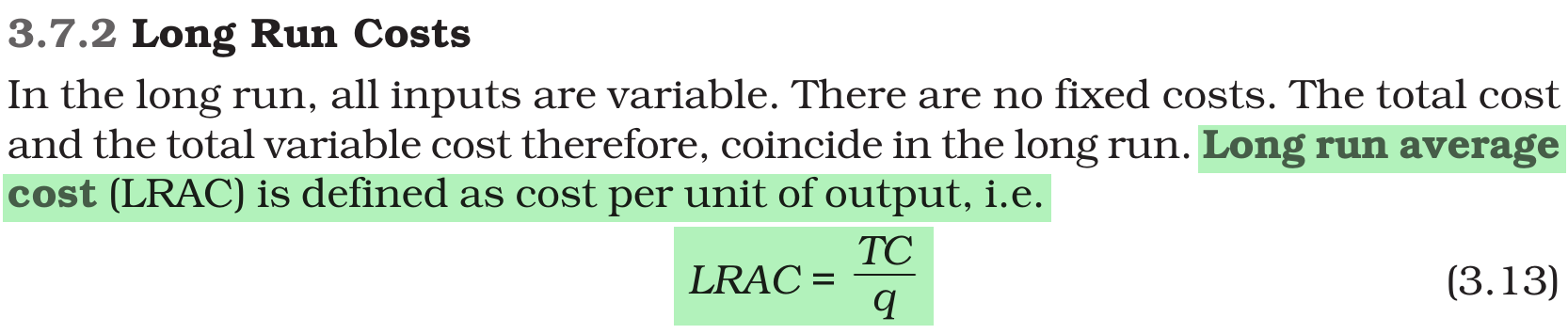
| (B) Long run Average Cost (LRAC) | (II) \( TVC/q \) |
| (C) Average Variable Cost (AVC) | (III) \( TC/q \) |
| (D) Average fixed cost (AFC) | (IV) \( TFC/q \) |
Choose the correct answer from the options given below:
Answer & explanation
Correct answer: option 2
The correct answer is Option (2) → (A)-(I), (B)-(III), (C)-(II), (D)-(IV)
An average cost divides a total cost by the output q. A marginal cost takes the change in total cost per unit change in output.
| List-I | List-II | Reason |
|---|---|---|
| (A) Short run Marginal Cost (SMC) | (I) \( ΔTC/Δq \) | SMC is the change in total cost per unit of change in output. |
| (B) Long run Average Cost (LRAC) | (III) \( TC/q \) | LRAC is the cost per unit of output. In the long run there is no fixed cost, so total cost is all variable. |
| (C) Average Variable Cost (AVC) | (II) \( TVC/q \) | AVC is the total variable cost per unit of output. |
| (D) Average fixed cost (AFC) | (IV) \( TFC/q \) | AFC is the total fixed cost per unit of output. |
NCERT (2026-27): Introductory Microeconomics — Chapter 3: Production and Costs
|