
Study the image given and answer the questions.
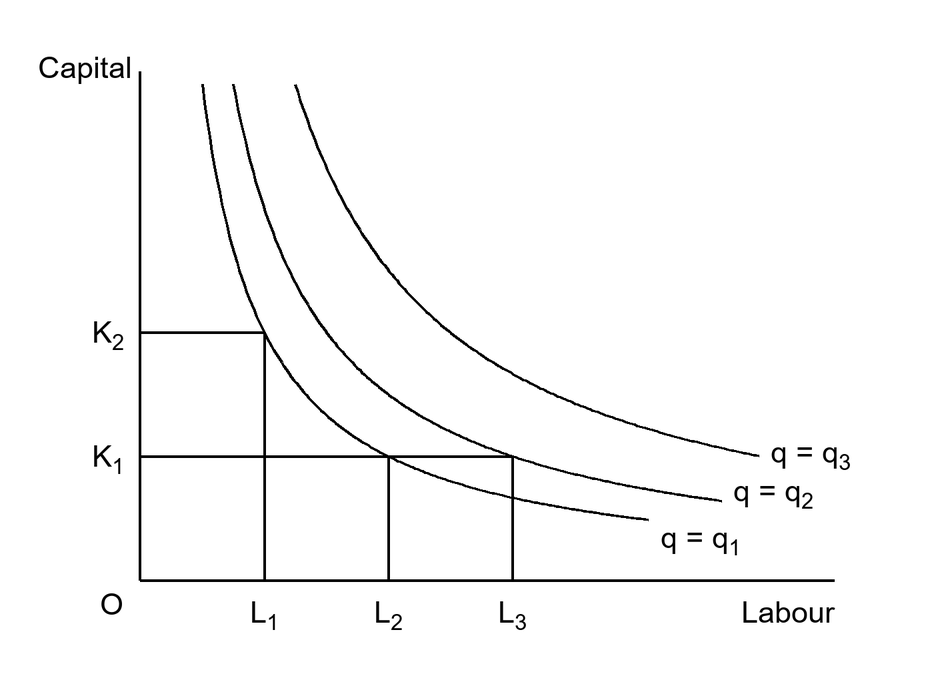
In the figure, a firm wants to produce the output q1. Which input combination on this isoquant will it use?
Answer & explanation
Correct answer: option 3
The correct answer is Option (3) → The one that costs the least at the given input prices
Every point on the isoquant q1 gives the same output, so output alone cannot decide. The firm then looks at cost: with input prices given, it picks the cheapest combination.
Option (1) The one that uses the smaller total quantity of inputs (labour plus capital) — Incorrect. Labour and capital have different prices, so adding their quantities says nothing about cost.
Option (2) Any one of them, because all of them give the same output — Incorrect. Same output does not mean same cost. The firm would not pay more than it needs to.
Option (3) The one that costs the least at the given input prices — Correct. For each level of output the firm chooses the least cost input combination.
Option (4) (L1, K2), because it uses less labour — Incorrect. Using less labour helps only if it lowers total cost, and that depends on the prices of labour and capital.
NCERT (2026-27): “3.7 Costs In order to produce output, the firm needs to employ inputs. But a given level of output, typically, can be produced in many ways. There can be more than one input combinations with which a firm can produce a desired level of output. In Table 3.1, we can see that 50 units of output can be produced by three different input combinations (L = 6, K = 3), (L = 4, K = 4) and (L = 3, K = 6). The question is which input combination will the firm choose? With the input prices given, it will choose that combination of inputs which is least expensive. So, for every level of output, the firm chooses the least cost input combination. Thus the cost function describes the least cost of producing each level of output given prices of factors of production and technology.” |