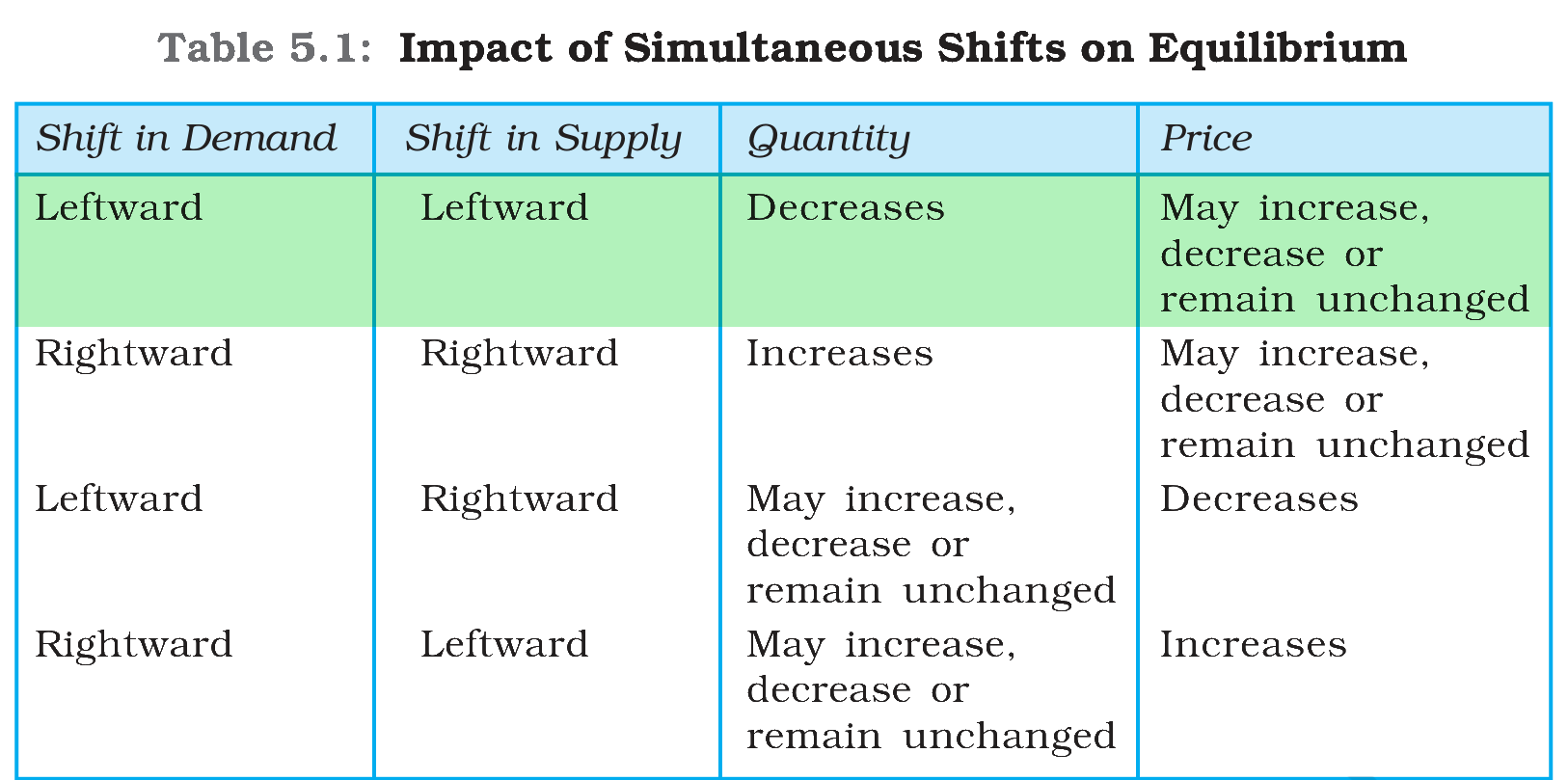
Cheena told her friend Meena that the market for cotton is in equilibrium and suddenly both market demand and market supply decrease. Meena said, “The effect on price will be uncertain.” Is Meena right, and why?
Answer & explanation
Correct answer: option 4
The correct answer is Option (4) → Yes, it depends on the magnitude of the shifts
When demand and supply both shift left, quantity falls for sure. The price may rise, fall or stay the same; it depends on which shift is bigger. So Meena is right.
Option (1) Yes, it depends on factors other than the magnitude of the shifts — Incorrect. Meena is right, but the reason is wrong: the price change depends on the magnitude of the shifts.
Option (2) No, it depends on the magnitude of the shifts — Incorrect. The effect on price is uncertain, so Meena is right.
Option (3) No, it depends on factors other than the magnitude of the shifts — Incorrect. Both parts are wrong: Meena is right, and the uncertainty comes from the sizes of the two shifts.
Option (4) Yes, it depends on the magnitude of the shifts — Correct. A bigger fall in demand lowers the price; a bigger fall in supply raises it; equal falls leave it unchanged.
Note: NTA uses the term ‘decrease in demand and supply’; NCERT describes this as a leftward shift of the demand and supply curves.
NCERT (2026-27): “Simultaneous Shifts of Demand and Supply … In the first two cases which are shown in the first two rows of the table, the impact on equilibrium quantity is unambiguous but the equilibrium price may change, if at all, in either direction depending on the magnitudes of shifts. In the next two cases, shown in the last two rows of the table, the effect on price is unambiguous whereas effect on quantity depends on the magnitude of shifts in the two curves.”
|