
Amines
Amines are important class of organic compounds which are basic in nature. They are generally derived by replacing one or more hydrogen atoms of ammonia molecule by alkyl / aryl group(s). In nature, they are generally found in proteins, vitamins, alkaloids and hormones. Two biologically active compounds namely adrenaline and ephedrine contain secondary amino group and are used to increase blood pressure.
Like ammonia, nitrogen atom of amines is trivalent and carries an unshared pair of electrons. Nitrogen orbitals in amines are therefore, sp3 hybridized and the geometry of amine is pyramidal. Due to the presence of unshared pair of electrons, the angle C-N-E (where E is C or H) is less than 109.5°.
Inductive effects, solvation effects, steric effects etc. affect the basic strength of amines. Amines are classified as primary (1°), secondary (2°), and tertiary (3°) depending upon the number of hydrogen atoms replaced by alkyl or aryl groups in ammonia molecule. Amines are engaged in intermolecular hydrogen bonding. Aliphatic and aromatic primary amines show positive carbylamine reaction. Amines can be prepared from various compounds like reduction of nitro, nitriles, amides etc. compounds. A colourless crystalline solid benzene diazonium chloride can be obtained from aniline by reacting with sodium nitrite and hydrochloric acid at 273-278 K.
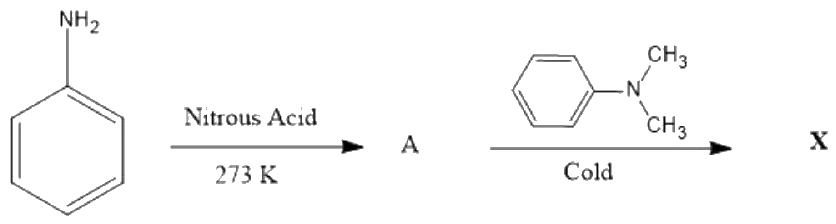
What would be the structure of final product X in the following chemical reaction?
Answer & explanation
Correct answer: option 3
The correct answer is Option (3) → p-(N,N-dimethylamino)azobenzene
The passage states that benzene diazonium chloride is obtained from aniline by reacting it with sodium nitrite and hydrochloric acid at 273–278 K. Nitrous acid is made in the mixture from these two reagents, so the first step of the scheme gives A = benzenediazonium chloride (diazotisation):
\( \displaystyle \ce{C6H5NH2 + NaNO2 + 2HCl} \xrightarrow{\text{273-278 K}} \ce{C6H5N2^+Cl^- + NaCl + 2H2O} \)
The low temperature is needed because the diazonium salt decomposes when warmed.
In the second step the diazonium ion acts as a weak electrophile. It attacks the ring of N,N-dimethylaniline, which is strongly activated by the –N(CH3)2 group, at the para position. The –N=N– group is kept and joins the two rings. This is a coupling reaction, an electrophilic substitution, and it gives a coloured azo compound:
\( \displaystyle \ce{C6H5N2^+Cl^- + C6H5N(CH3)2} \xrightarrow{\text{cold}} \ce{C6H5-N=N-C6H4-N(CH3)2} + \ce{HCl} \)
So X is p-(N,N-dimethylamino)azobenzene, structure 3, with the azo group para to the –N(CH3)2 group.
Why the other options are incorrect
Option (1) the compound with a –CH2–N=N– link on nitrogen — Incorrect. Coupling is a substitution on the benzene ring. The diazonium ion does not attack a methyl group on nitrogen.
Option (2) the hydrazo compound (–NH–NH–) — Incorrect. Coupling keeps the –N=N– double bond of the diazonium ion. An –NH–NH– link would need a separate reduction step.
Option (4) 2,2′-dimethylazobenzene — Incorrect. It has no –N(CH3)2 group, only methyl groups on the rings. A product of N,N-dimethylaniline must keep its –N(CH3)2 group.
NCERT (2026-27 edition):
Reactions involving Retention of Diazo Group: Coupling Reactions – “The azo products obtained have an extended conjugate system having both the aromatic rings joined through the –N=N– bond. These compounds are often coloured and are used as dyes. Benzene diazonium chloride reacts with phenol in which the phenol molecule at its para position is coupled with the diazonium salt to form p-hydroxyazobenzene. This type of reaction is known as coupling reaction. Similarly the reaction of diazonium salt with aniline yields p-aminoazobenzene. This is an example of electrophilic substitution reaction.”