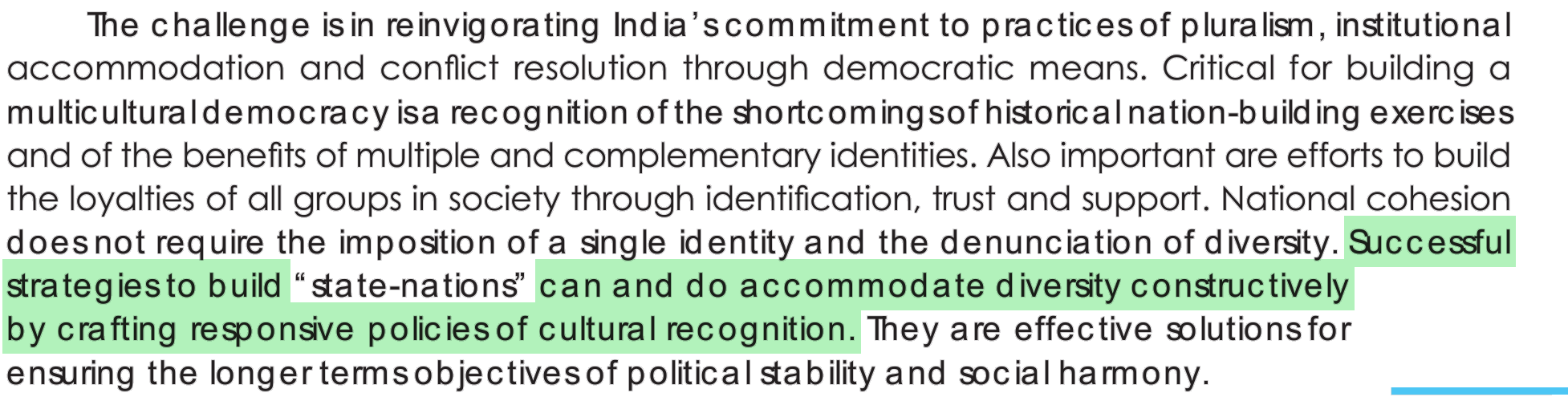
Read the passage and answer the following questions:-
In terms of the nation-state's relationship with community identities, the Indian case fits neither the assimilationist nor the integrationist model described in Box 6.2. From its very beginning the independent Indian state has ruled out an assimilationist model. However, the demand for such a model has been expressed by some sections of the dominant Hindu community. Although 'nationalist' integration is a constant theme in state policy, India has not been integrationist in the way that Box 6.2 describes. The constitution declares the state to be a secular state, but religion, language and other such factors are not banished from the public sphere. In fact these communities have been explicitly recognised by the state. By international standards, very strong constitutional protection is offered to minority religions. In general India's problems have been more in the sphere of implementation and practice rather than laws or principles. But on the whole, India can be considered a good example of a state nation though it is not entirely free from the problems common to nation states.
The success of India's state building can be attributed to which of the following factors?
Answer & explanation
Correct answer: option 1
The correct answer is Option (1) → accommodating diversity through responsive policies
Option (1) accommodating diversity through responsive policies — Correct. India fits neither the assimilationist nor the integrationist model: it recognises its communities and gives very strong constitutional protection to minority religions. Successful strategies to build ‘state-nations’ accommodate diversity constructively by crafting responsive policies of cultural recognition, and this is why India is a good example of a ‘state-nation’.
Option (2) assimilating diversity through responsive policies — Incorrect. Assimilation means persuading, encouraging or forcing all citizens to adopt a uniform set of cultural values, usually those of the dominant group. It wipes out diversity instead of responding to it, and the Indian state ruled out the assimilationist model from its very beginning.
Option (3) integrating diversity through coercive policies — Incorrect. Integration keeps public culture to a common national pattern and pushes all ‘non-national’ cultures into the private sphere. India has not been ‘integrationist’, and its policies rest on recognition, not force.
Option (4) accommodating diversity through coercive policies — Incorrect. Accommodation and coercion pull in opposite directions. Suppressing identities can provoke the opposite effect of intensifying community identity, so diversity is accommodated by responsive policies that give communities space, never by force.
NCERT: Indian Society — Chapter 6: The Challenges of Cultural Diversity, Box 6.2 (2025-26)
|