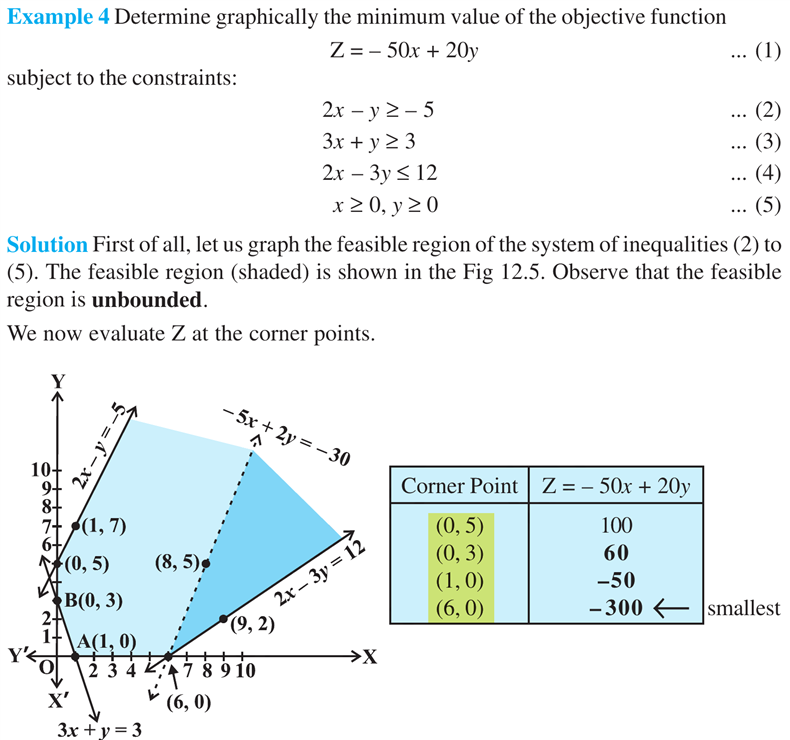
The corner points of the feasible region of the LPP: Minimize \(z = -50x + 20y\) subject to \(2x - y \ge -5, 3x + y \ge 3, 2x - 3y \le 12\) and \(x, y \ge 0\) are
Answer & explanation
Correct answer: option 3
The correct answer is Option (3) → \((0,3), (0,5), (1,0), (6,0)\)
Since \(x, y \ge 0\), the region lies in the first quadrant. Its corner points lie where the boundary lines meet the axes or each other.
On the y-axis (x = 0) the constraints become
\(-y \ge -5 \Rightarrow y \le 5\)
\(y \ge 3\)
\(-3y \le 12 \Rightarrow y \ge -4\)
So \(3 \le y \le 5\), with end points (0, 3) and (0, 5).
On the x-axis (y = 0) the constraints become
\(2x \ge -5\) (true for \(x \ge 0\))
\(3x \ge 3 \Rightarrow x \ge 1\)
\(2x \le 12 \Rightarrow x \le 6\)
So \(1 \le x \le 6\), with end points (1, 0) and (6, 0).
The three slanting lines meet each other only outside the first quadrant:
\(2x - y = -5\) and \(3x + y = 3\) meet where \(x = -0.4\)
\(3x + y = 3\) and \(2x - 3y = 12\) meet where \(y = -\frac{30}{11}\)
\(2x - y = -5\) and \(2x - 3y = 12\) meet where \(y = -8.5\)
So the corner points are (0, 3), (0, 5), (1, 0) and (6, 0). The region is unbounded: it runs off between the lines \(y = 2x + 5\) and \(2x - 3y = 12\).
Shortcut: (0, 6) fails \(2x - y \ge -5\), since \(-6 \lt -5\), which rules out Options (1) and (4). (3, 0) lies on the x-axis between (1, 0) and (6, 0) but on no other boundary line, so it is not a corner, which rules out Option (2).
NCERT (2026-27 edition):
Graphical Method of Solving Linear Programming Problems