Which layer of microsporangium nourishes the developing pollen grains?
Answer & explanation
Correct answer: option 2
The correct answer is Option (2) → Tapetum
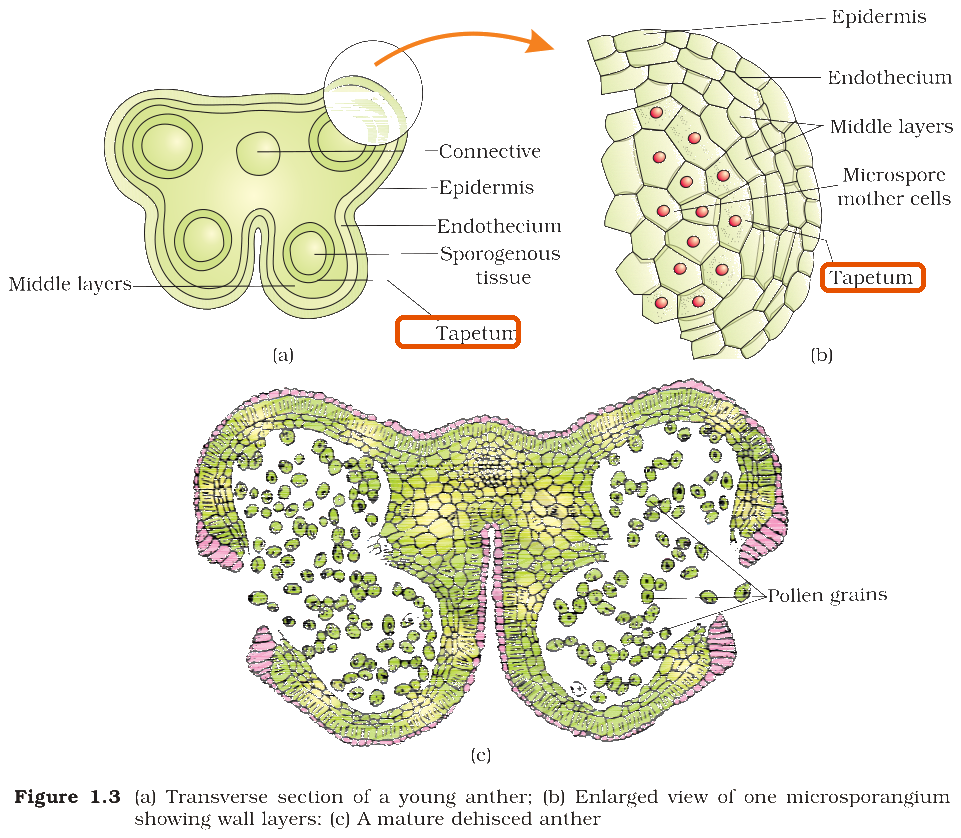
A young anther has four microsporangia. The pollen grains develop inside them. The wall of each microsporangium has four layers. From outside to inside, they are the epidermis, the endothecium, the middle layers and the tapetum.
(1) Epidermis — Incorrect. The epidermis is the outermost layer. It protects the microsporangium.
(2) Tapetum — Correct. The tapetum is the innermost wall layer. It lies next to the developing pollen grains and nourishes them. Its cells have dense cytoplasm and often more than one nucleus.
(3) Endothecium — Incorrect. The endothecium lies just below the epidermis. It gives protection and helps the anther to burst open (dehiscence) to release the pollen.
(4) Middle layers — Incorrect. The middle layers also protect the microsporangium and help in dehiscence. They do not feed the pollen grains.
Note: The same question was also asked in CUET (UG) 2025 on 27-05-2025 (Slot 2), and in CUET (UG) 2023 on 15-06-2023 (Slot 1), and a similar question in CUET (UG) 2023 on 11-06-2023 (Slot 3), and in CUET (UG) 2022 on 16-07-2022 (Slot 1).
NCERT Extract:
Stamen, Microsporangium and Pollen Grain – “… Structure of microsporangium: In a transverse of an anther section, a typical microsporangium appears near circular in outline. It is generally surrounded by four wall layers (Figure 1.3b)– the epidermis, endothecium, middle layers and the tapetum. The outer three wall layers perform the function of protection and help in dehiscence of anther to release the pollen. The innermost wall layer is the tapetum. It nourishes the developing pollen grains.”