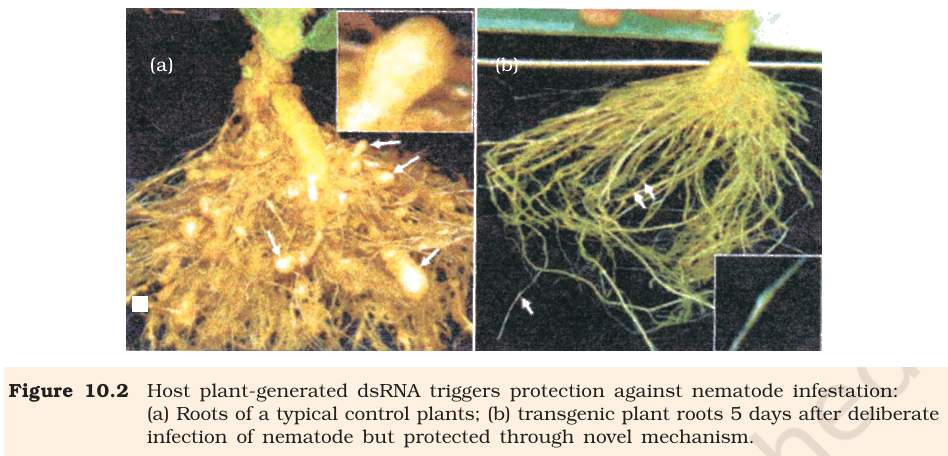
A new strategy called RNA interference was adopted to prevent the infestation by nematode Meloidogyne incognita in the roots of tobacco plants. The technique involves:
(A) Nematode specific gene were introduced in tobacco plant using Agrobacterium vector.
(B) It produces anti-sense RNA in the host cells.
(C) It involves formation of dsRNA and silences the specific mRNA.
(D) Parasite could not survive in the transgenic host plant.
Choose the correct answer from the options given below:
Answer & explanation
Correct answer: option 3
The correct answer is Option (3) → (A), (C) and (D) only
RNA interference (RNAi) is a method of cellular defence in which a specific mRNA is silenced by a complementary double-stranded RNA (dsRNA). It was used to protect tobacco plants from the nematode that infects their roots.
(A) Nematode specific gene were introduced in tobacco plant using Agrobacterium vector. — Correct. Agrobacterium vectors carried the nematode-specific genes into the host plant.
(B) It produces anti-sense RNA in the host cells. — Incorrect. The introduced DNA made both sense and anti-sense RNA. Anti-sense RNA alone is only half of the mechanism, because the two strands must pair up.
(C) It involves formation of dsRNA and silences the specific mRNA. — Correct. The sense and anti-sense RNAs are complementary and form dsRNA. This starts RNAi and silences the specific mRNA of the nematode.
(D) Parasite could not survive in the transgenic host plant. — Correct. With its mRNA silenced, the parasite could not survive in the transgenic plant.
Note: Statement (B) names only anti-sense RNA, while the host plant makes both sense and anti-sense RNA. It is therefore treated as incomplete, and this is why Option (1) is not the answer.
NCERT Extract:
Biotechnological Applications in Agriculture – “… A nematode Meloidegyne incognitia infects the roots of tobacco plants and causes a great reduction in yield. A novel strategy was adopted to prevent this infestation which was based on the process of RNA interference (RNAi). RNAi takes place in all eukaryotic organisms as a method of cellular defense. This method involves silencing of a specific mRNA due to a complementary dsRNA molecule that binds to and prevents translation of the mRNA (silencing). The source of this complementary RNA could be from an infection by viruses having RNA genomes or mobile genetic elements (transposons) that replicate via an RNA intermediate. Using Agrobacterium vectors, nematode-specific genes were introduced into the host plant (Figure 10.2). The introduction of DNA was such that it produced both sense and anti-sense RNA in the host cells. These two RNA’s being complementary to each other formed a double stranded (dsRNA) that initiated RNAi and thus, silenced the specific mRNA of the nematode. The consequence was that the parasite could not survive in a transgenic host expressing specific interfering RNA.”