
CUETMOCK
  • Pricing
  • Mentors
Log inStart freeStart free mocks→

First test, then trust

Try a free CUET mock test.

Join 5,00,000+ students who rehearsed exam day on the exact NTA screen before sitting CUET. On the web and on Android.

Start free mocks →Get the Android app
CUETMOCK

India's #1 CUET Mock Test Platform. Original NCERT-based questions on the exact NTA exam screen — trusted by 5,00,000+ students since CUET 2022.

Get it onGoogle PlayScan to download the CUETMOCK app

Mock tests

  • CUET mock test series
  • Commerce mocks
  • Humanities (Arts) mocks
  • Science mocks
  • Languages & GAT mocks
  • Free practice questions
  • Pricing

Resources

  • CUET exam guide
  • CUET syllabus
  • Universities accepting CUET
  • Expert blogs
  • News & notifications
  • Webinars & counselling
  • CUET score calculator
  • How we estimate your rank
  • FAQs

Company

  • About us
  • Our leadership & team
  • Our toppers
  • Mentors
  • For schools
  • Contact us
  • Terms
  • Privacy
  • Refund policy

Talk to us

+91 7696 6630 56info@cuetmock.comWhatsApp us

Our other platforms

  • JEE Mock — For IIT-JEE aspirants
  • NEET Mock — For NEET aspirants

Newsletter

Exam updates, study material and offers — no spam.

© 2026 NYC Ventures Pvt. Ltd.

701-702, Royal Business Park, Zirakpur, Punjab - 140603

  • Terms of use
  • Privacy policy
  • Refund policy
  • Contact us

iCUETMOCK is an independent preparation platform, not affiliated with the National Testing Agency (NTA). Always check exam details on the official NTA website.

  • Home
  • Mock tests
  • CUET guide
  • Pricing
  • Log in
Home/Practice questions/Physics
PhysicsDual Nature of Radiation and Matter

How does the graph of photocurrent against collector potential in the…

Read the following passage and answer the questions.

A student studies a photocell. It is an evacuated glass tube with a quartz window. Inside the tube are an emitter plate C and a collector plate A. Plate C is coated with a metal that gives out electrons even in red light. A battery and a commutator let her make plate A positive or negative with respect to C. A microammeter reads the photocurrent.

In the first run, she shines a red laser pointer on plate C. The light has a wavelength of 620 nm, and the pointer gives out a power of 2.4 mW. She records the photocurrent as she changes the potential of A from positive to negative values. In the second run, she uses a red laser of the same wavelength but twice the power. In the third run, she uses a violet laser of wavelength 410 nm. She adjusts it so that the same number of photons reach plate C each second as in the first run.

(Take \(hc = 1240\ \mathrm{eV\,nm}\) and \(1\ \mathrm{eV} = 1.6\times10^{-19}\ \mathrm{J}\).)

How does the graph of photocurrent against collector potential in the third run compare with that in the first run?

Answer & explanation+

Correct answer: option 2

The correct answer is Option (2) → The stopping potential is more negative, and the saturation current is the same.

Violet light of wavelength 410 nm has a higher frequency than red light of 620 nm. In the third run only the frequency changes. The same number of photons reaches plate C each second as in the first run.

Option (1) The stopping potential is the same, but the saturation current is larger. — Incorrect. The stopping potential depends on the frequency of the light, and the frequency has changed. The same number of photons each second gives the same number of photoelectrons, so the saturation current does not grow either.

Option (2) The stopping potential is more negative, and the saturation current is the same. — Correct. Each violet photon has more energy, so the fastest photoelectrons leave C with more kinetic energy. A larger retarding potential is needed to stop them. The same number of photons each second frees the same number of photoelectrons. So the saturation current stays the same, as the curves below show.

Option (3) The stopping potential is less negative, and the saturation current is the same. — Incorrect. A less negative stopping potential would need light of a lower frequency, that is, a wavelength longer than 620 nm.

Option (4) Both the stopping potential and the saturation current are the same. — Incorrect. Only the saturation current stays the same. The violet curve meets the potential axis farther on the negative side.

NCERT (2026-27):
Effect of frequency of incident radiation on stopping potential – “… We obtain different values of stopping potential but the same value of the saturation current for incident radiation of different frequencies. The energy of the emitted electrons depends on the frequency of the incident radiations. The stopping potential is more negative for higher frequencies of incident radiation.”
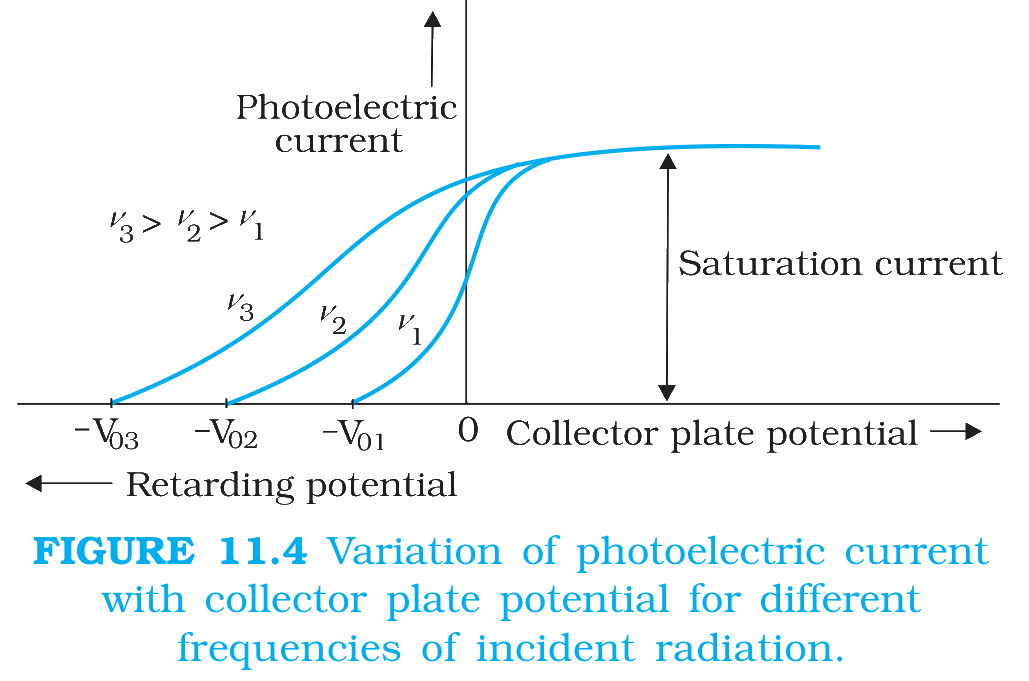
FIGURE 11.4 Variation of photoelectric current with collector plate potential for different frequencies of incident radiation

Advertisement

Practise more on Dual Nature of Radiation and Matter

Chapter-wise mocks on the real NTA exam screen, with solutions and your rank. Your first mocks are free.

Start free mocks →

Advertisement

Next questions

  1. The pair in which both the species have the same magnetic moment (spin only value) is:Chemistry · Inorganic: Coordination Compounds
  2. At break even point R(x) is equal to ___________. (where R(x) is revenue function)Applied Maths. Section B2 · Calculus
  3. Which of the following Indian was the first recipient of Ramon Magsaysay Award?General Aptitude Test · General Knowledge
  4. Which historian remarked that South Africa was "the making of the Mahatma"?History · Modern India: Mahatma Gandhi and the Nationalist movement
  5. The resolving power of a telescope can be increased byPhysics · Ray Optics
  6. Which of the following in motion cannot be deflected by magnetic field?Physics · Nuclei
  7. Choose the option that best explains the underlined phrasal verb:Aarav was nervous about sharing a hostel room, but he and his new roommate…English · Grammar: Phrasal Verb
  8. The volume of prism is 308 cm3 and height is 11 cm. The base area of the prism is:General Aptitude Test · Quantitative Reasoning
  9. Mr. X invested Rs. 4,00,000 in shares for 5 years. The value of this investment was Rs. 4,50,000 at the end of the second year, Rs. 4,90,00…Applied Maths. Section B2 · Financial Mathematics
  10. Arrange the following British officers in a chronological order of their Governor-Generalship in India: (A) Lord Canning(B) Lord Wellesley(…History · Modern India: Rebels and the Raj