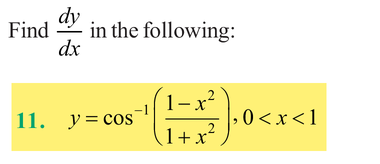
If \(y = \cos^{-1}\left(\displaystyle\frac{1-x^2}{1+x^2}\right), 0 \lt x \lt 1\), then \(\displaystyle\frac{dy}{dx}\) is equal to
Answer & explanation
Correct answer: option 1
The correct answer is Option (1) → \(\displaystyle\frac{2}{1+x^2}\)
Let \(x = \tan\theta\). Since \(0 \lt x \lt 1\), \(0 \lt \theta \lt \frac{\pi}{4}\). By the double-angle formula:
\( \displaystyle \frac{1 - \tan^2\theta}{1 + \tan^2\theta} = \cos 2\theta \)
\(y = \cos^{-1}(\cos 2\theta)\)
Here \(0 \lt 2\theta \lt \frac{\pi}{2}\), which lies in the principal range \([0, \pi]\) of \(\cos^{-1}\), so
\(y = 2\theta = 2\tan^{-1}x\)
\( \displaystyle \frac{dy}{dx} = \frac{2}{1 + x^2} \)
NCERT (2026-27 edition):
Derivatives of Inverse Trigonometric Functions