
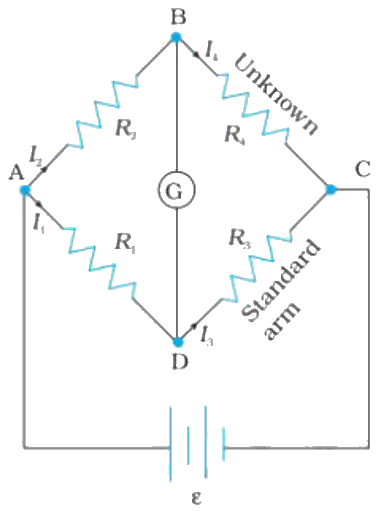
The Wheatstone bridge is an arrangement of four resistances: \( R_{1}, R_{2}, R_{3}, R_{4} \) as shown in the figure given below. The null-point condition is not given by
Answer & explanation
Correct answer: option 4
The correct answer is Option (4) → \( R_{1}R_{2} = R_{3}R_{4} \)
In the figure, \( R_{2} \) is the arm \( AB \), \( R_{1} \) is \( AD \), \( R_{4} \) is \( BC \) and \( R_{3} \) is \( DC \). At the null point no current flows through the galvanometer, so \( B \) and \( D \) are at the same potential. The ratio of the resistances in the arms \( AB \) and \( BC \) equals that in \( AD \) and \( DC \) (the balance condition).
\( \displaystyle \frac{R_{2}}{R_{1}} = \frac{R_{4}}{R_{3}} \)
The other forms are this relation rewritten, so each of them is the same condition.
Option (1) \( R_{2}/R_{1} = R_{4}/R_{3} \) — A null-point condition. It is the balance condition as derived above.
Option (2) \( R_{1}/R_{2} = R_{3}/R_{4} \) — A null-point condition. Inverting both sides of the balance condition gives \( R_{1}/R_{2} = R_{3}/R_{4} \).
Option (3) \( R_{1}R_{4} = R_{2}R_{3} \) — A null-point condition. Cross-multiplying the balance condition gives \( R_{2}R_{3} = R_{1}R_{4} \).
Option (4) \( R_{1}R_{2} = R_{3}R_{4} \) — Not a null-point condition. It pairs \( R_{1} \) with \( R_{2} \) and \( R_{3} \) with \( R_{4} \), which is not the balance condition; it does not follow from the relation above.
NCERT (2026-27):
Summary – “… The Wheatstone bridge is an arrangement of four resistances – R1, R2, R3, R4 as shown in the text. The null-point condition is given by
\( \displaystyle \frac{R_1}{R_2} = \frac{R_3}{R_4} \)
using which the value of one resistance can be determined, knowing the other three resistances.”