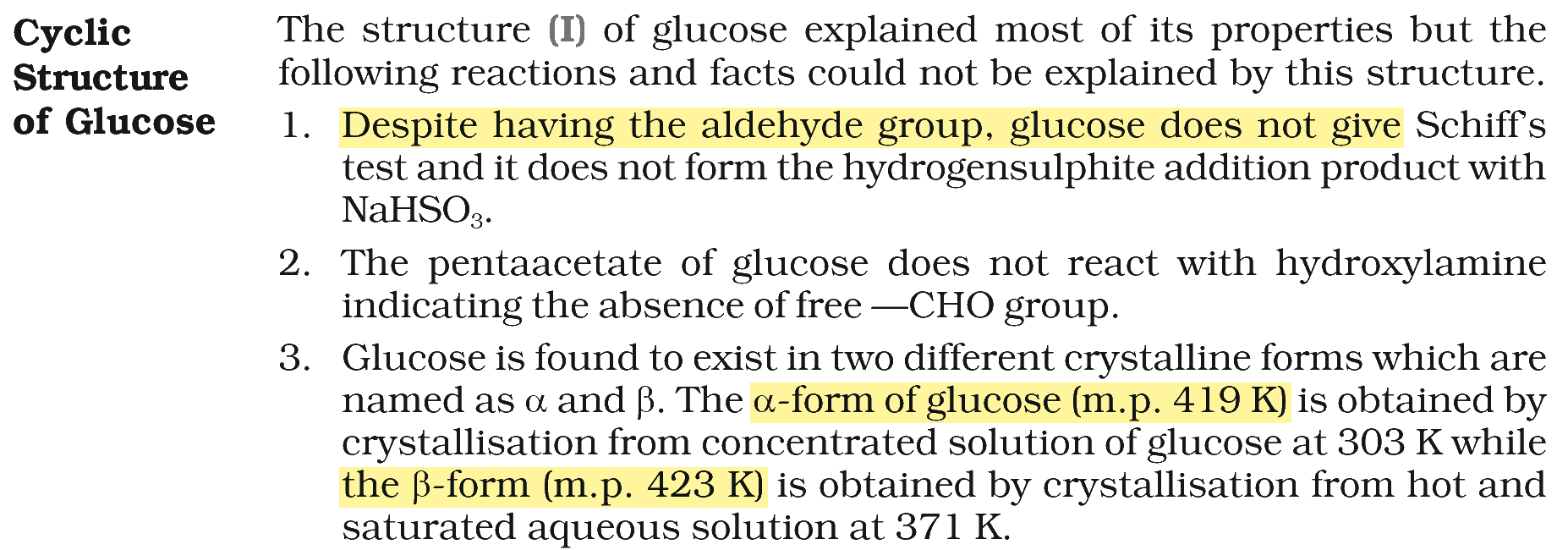
With reference to the cyclic structure of glucose, which of the following are correct statements ?
A. Glucose does not give Schiff's test.
B. Glucose forms the hydrogen sulphite addition product with NaHSO3.
C. The melting point of the α-form of glucose is 419 K whereas the β-form is 423 K.
D. The existence of α-form and β-form of glucose explains the presence of the free ketonic group.
Choose the correct answer from the options given below:
Answer & explanation
Correct answer: option 2
The correct answer is Option (2) → A and C only
The open-chain structure of glucose has a free –CHO group, yet glucose does not behave fully like an aldehyde.
These facts are explained by a cyclic structure. The –OH group on C-5 adds to the –CHO group, forming a six-membered ring (a cyclic hemiacetal) with no free carbonyl group. C-1 becomes a new chiral centre, giving the two anomers, α-D-glucose and β-D-glucose.
A. Glucose does not give Schiff's test. — Correct. In the cyclic form there is no free –CHO group to react with Schiff’s reagent.
B. Glucose forms the hydrogen sulphite addition product with NaHSO3. — Incorrect. Glucose does not form this addition product. This failure is one of the facts that the cyclic structure was proposed to explain.
C. The melting point of the α-form of glucose is 419 K whereas the β-form is 423 K. — Correct. The α-form (m.p. 419 K) crystallises from a concentrated solution at 303 K. The β-form (m.p. 423 K) crystallises from a hot, saturated solution at 371 K.
D. The existence of α-form and β-form of glucose explains the presence of the free ketonic group. — Incorrect. Glucose is an aldose, so it has no ketonic group. The two forms are explained by the cyclic structure, which has no free carbonyl group at all.
NCERT (2026-27 edition):
Cyclic Structure of Glucose