Match List-I with List-II
| List-I | List-II | ||
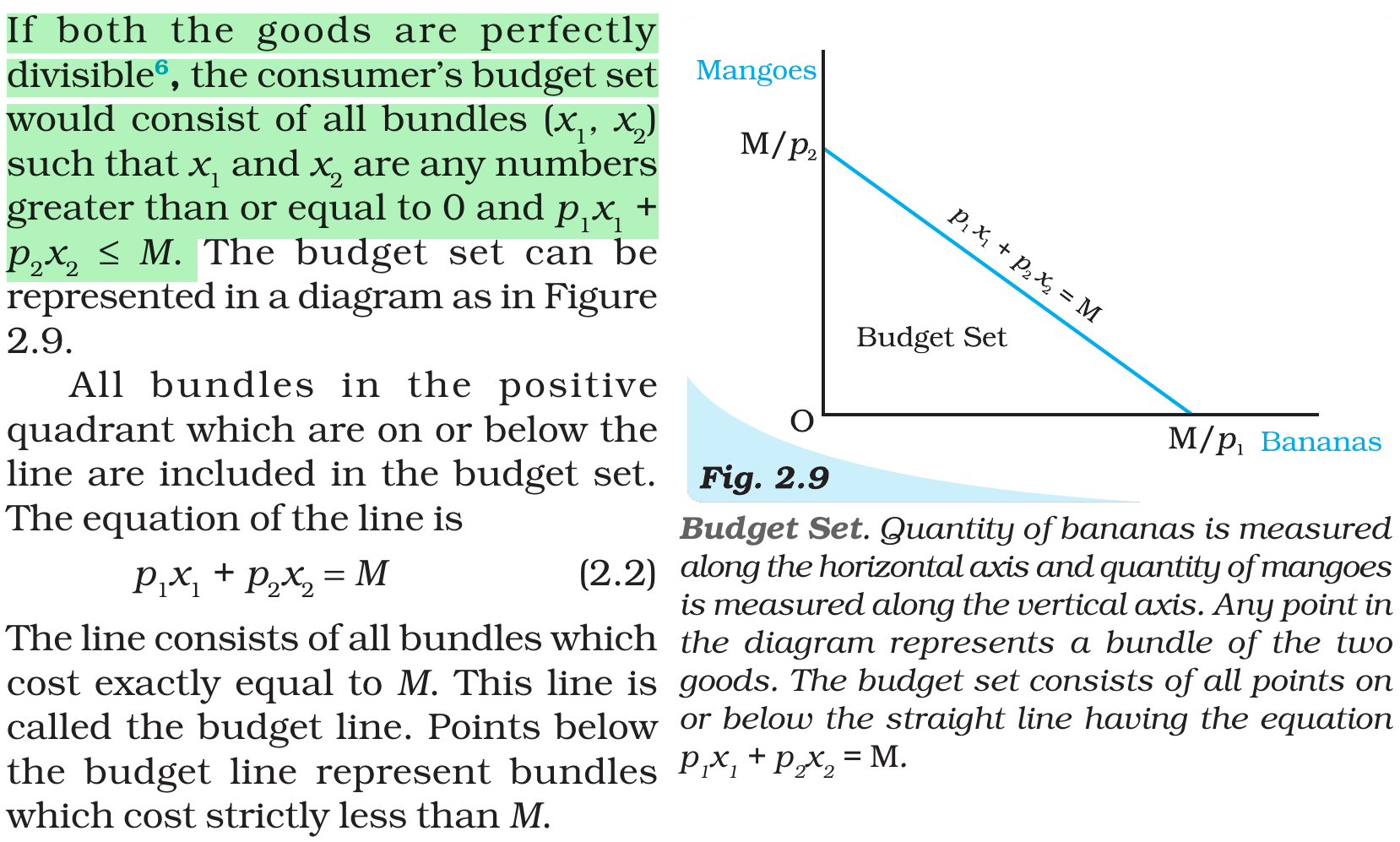
| (A) | Budget Set | (I) | \( -(P_1/P_2) \) |
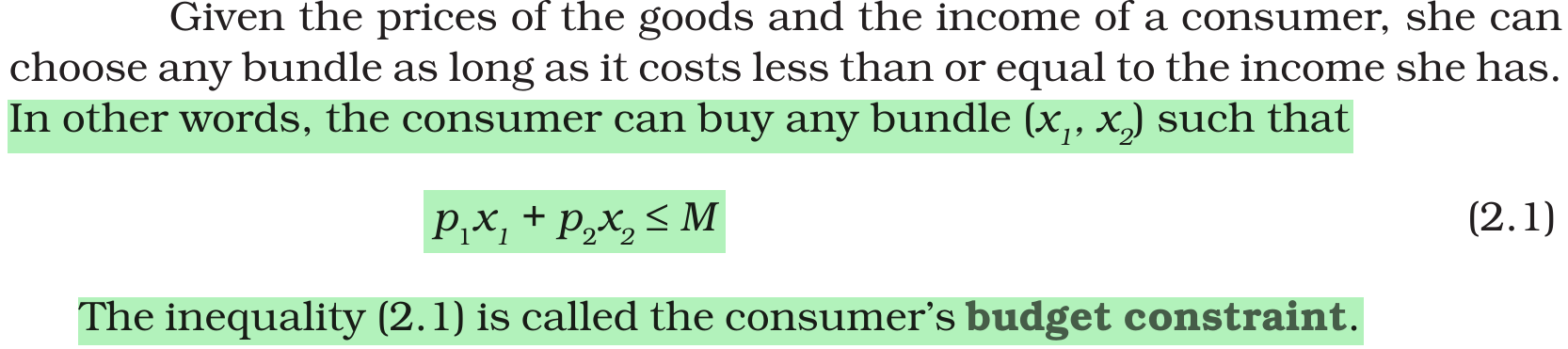
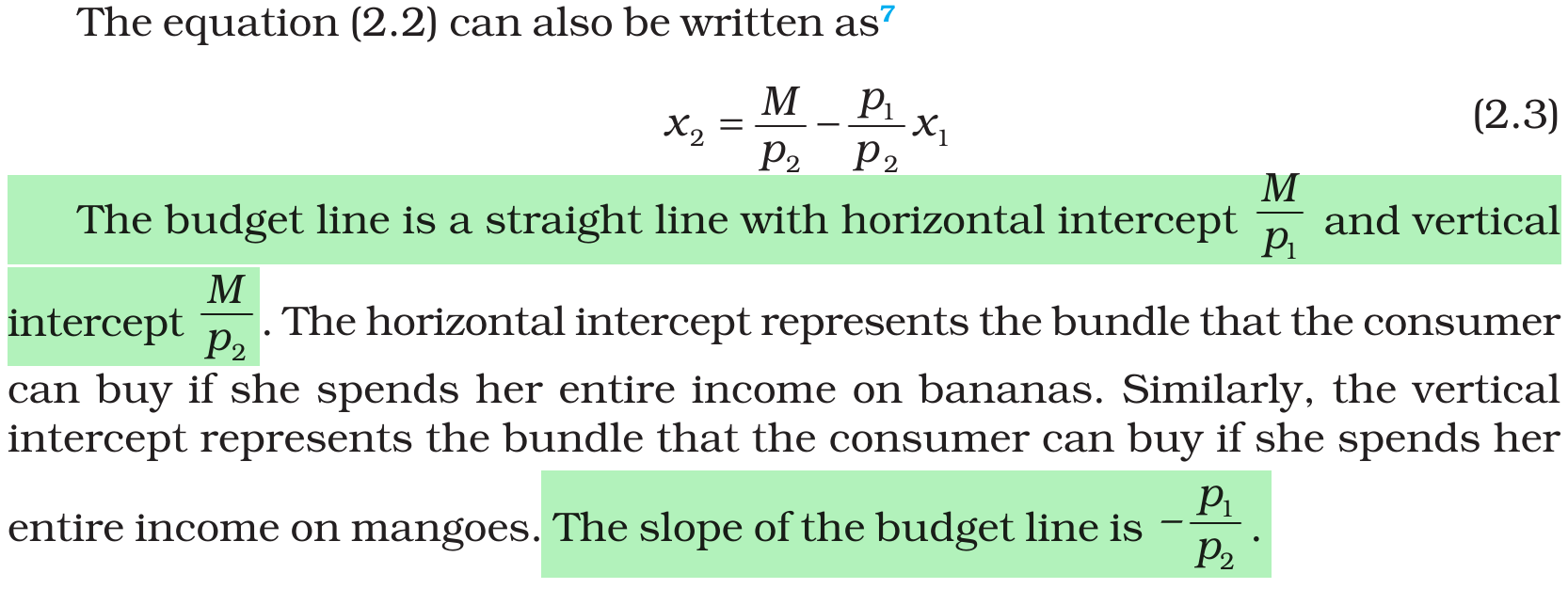
| (B) | Slope of the budget line | (II) | \( M/P_1 \) |
| (C) | Horizontal intercept of the budget line | (III) | \( P_1 X_1+ P_2 X_2 ≤ M \) |
| (D) | Vertical intercept of the budget line | (IV) | \( M/P_2 \) |
Choose the correct answer from the options given below:
Answer & explanation
Correct answer: option 2
The correct answer is Option (2) → (A)-(III), (B)-(I), (C)-(II), (D)-(IV)
A consumer with income M buys two goods at prices P1 and P2. Good 1 is on the horizontal axis and good 2 on the vertical axis. The budget line joins the bundles that cost the whole income M.
| List-I | List-II | Reason |
|---|---|---|
| (A) Budget Set | (III) \( P_1 X_1+ P_2 X_2 ≤ M \) | The budget set is all the bundles the consumer can afford. Their cost is less than or equal to income. |
| (B) Slope of the budget line | (I) \( -(P_1/P_2) \) | The slope is the price ratio with a minus sign. To buy more of good 1, the consumer must give up some of good 2. |
| (C) Horizontal intercept of the budget line | (II) \( M/P_1 \) | Here the whole income buys good 1 only. Income divided by its price gives the quantity. |
| (D) Vertical intercept of the budget line | (IV) \( M/P_2 \) | Here the whole income buys good 2 only. Income divided by its price gives the quantity. |
Note: A same/similar question was asked in CUET (UG) in the papers below.
| 2026 | 2025 | 2024 | 2023 | 2022 |
| – | 15-05 S1 28-05 S2* | – | – | – |
* A similar question.
NCERT (2026-27): Introductory Microeconomics — Chapter 2: Theory of Consumer Behaviour
|