
Cell division itself a mode of reproduction in organisms like :
(A) Yeast
(B) Amoeba
(C) Paramecium
(D) Fruitfly
Choose the correct answer from the options given below:
Answer & explanation
Correct answer: option 4
The correct answer is Option (4) → (A), (B) & (C) Only
In single-celled organisms the parent cell itself divides to give new individuals, so cell division is itself a mode of reproduction.
(A) Yeast — Correct. Yeast is a single-celled fungus. It divides by budding: a small bud forms on the cell, gets a nucleus and separates as a new yeast cell.
(B) Amoeba — Correct. Amoeba divides into two by binary fission.
(C) Paramecium — Correct. Paramecium also reproduces by binary fission.
(D) Fruitfly — Incorrect. The fruitfly is a multicellular animal that reproduces sexually, by gametes. Its cell divisions only make the body grow.
Note: This question is from Chapter 1, Reproduction in Organisms, of the pre-rationalised NCERT book. This chapter is not in the present NCERT book (2026-27). The extract below is from the pre-rationalised edition.
NCERT Extract (Pre-rationalised edition, Chapter 1, Reproduction in Organisms):
Asexual Reproduction – “… Let us see how widespread asexual reproduction is, among different groups of organisms. Asexual reproduction is common among single-celled organisms, and in plants and animals with relatively simple organisations. In Protists and Monerans, the organism or the parent cell divides by mitosis into two to give rise to new individuals (Figure1.2). Thus, in these organisms cell division is itself a mode of reproduction.”
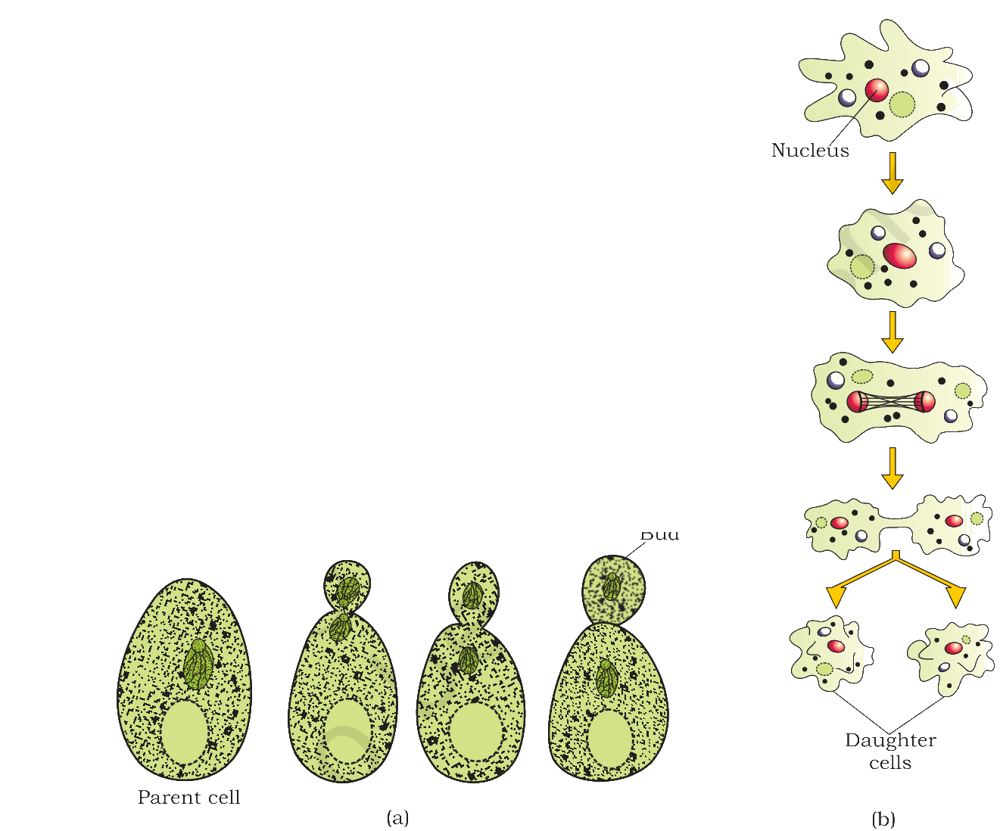
Figure 1.2 Cell division in unicellular organism: (a) Budding in yeast; (b) Binary fission in Amoeba