
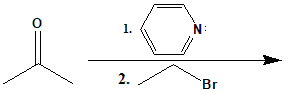
Identify \(A\):
Answer & explanation
Correct answer: option 4
The correct answer is Option (4) → Pentan-2-one (CH3COCH2CH2CH3)
The hydrogen atoms on the α-carbon of a ketone are weakly acidic, because the carbonyl group withdraws electrons and the conjugate base (the enolate ion) is stabilised by resonance. A strong base removes an α-hydrogen of acetone to give the enolate. Its carbon then attacks ethyl bromide in an SN2 reaction, and the ethyl group is joined to the α-carbon (α-alkylation):
\( \ce{CH3COCH3} \xrightarrow{\text{strong base}} \ce{CH3COCH2^-} \xrightarrow{\ce{CH3CH2Br}} \ce{CH3COCH2CH2CH3 + Br^-} \)
So A is pentan-2-one.
Why the other options are incorrect
Option (1) Acetone — Incorrect. This is the starting material; the ethyl group from ethyl bromide is added to it.
Option (2) Pentan-3-one — Incorrect. CH3CH2COCH2CH3 has an ethyl group on each side of C=O. Alkylation adds one ethyl group to an α-carbon of acetone, so one side stays CH3.
Option (3) 3-Methylbutan-2-one — Incorrect. CH3COCH(CH3)2 has two methyl groups on the same α-carbon. It would need two methylations, not one ethylation.
Note: The question is from beyond the NCERT textbook.