


CUET Preparation Today
Aldol condensation reaction is not given by: |
Ethanl Butanal 3-Methyl butanal 2,2-Dimethyl butane |
2,2-Dimethyl butane |
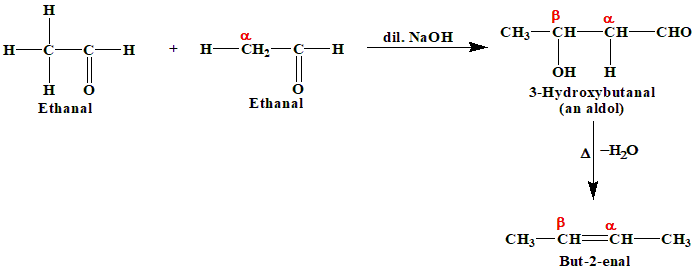
The correct answer is option 4. 2,2-Dimethyl butane. Aldol Condensation is a reaction in organic chemistry where an aldehyde or ketone, containing at least one α-hydrogen, reacts with another aldehyde or ketone under basic conditions to form a β-hydroxy aldehyde or ketone (an aldol). This product can further dehydrate to form an α,β-unsaturated carbonyl compound. Key Conditions for Aldol Condensation: Presence of α-Hydrogens: The molecule must have at least one hydrogen atom on the carbon adjacent to the carbonyl group. These α-hydrogens are crucial for the formation of the enolate ion, which is an intermediate in the aldol reaction. Basic Conditions: The reaction typically requires a strong base to deprotonate the α-hydrogens and form the enolate ion. Analysis of the Given Compounds 1. Ethanal (CH₃CHO): Ethanal (acetaldehyde) has the structure CH₃CHO. The carbonyl group is adjacent to a carbon that has α-hydrogens (on the CH₃ group). Ethanal can form an enolate ion when treated with a base. The aldol condensation will proceed to give 3-hydroxybutanal, which can further dehydrate to form But-2-ene.
Butanal has the structure CH₃CH₂CH₂CHO. The carbonyl group is adjacent to a carbon with α-hydrogens (on the CH₂ group next to the carbonyl). Butanal can form an enolate ion under basic conditions. The aldol condensation will produce 2-ethyl-3-hydroxypentanal, which can further dehydrate to form 2-ethyl-2-hexenal.
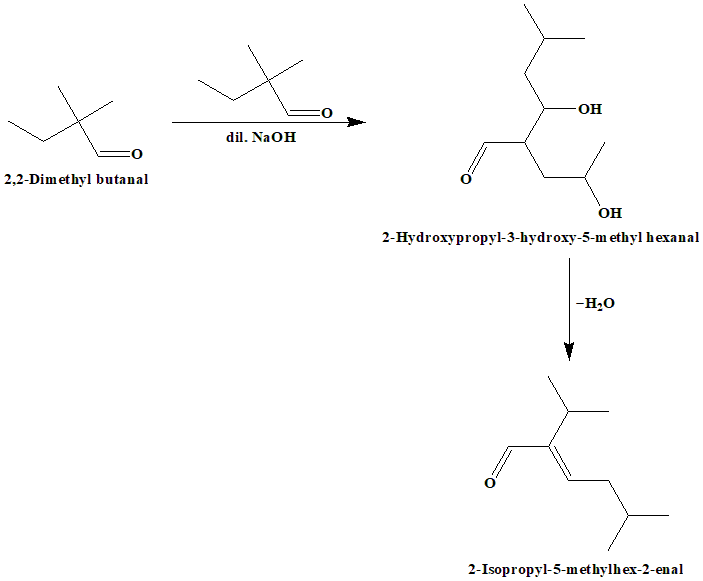
3. 3-Methylbutanal (CH₃CH₂CH(CH₃)CHO): 3-Methylbutanal has the structure CH₃CH₂CH(CH₃)CHO. The carbonyl group is adjacent to a carbon with α-hydrogens (on the CH₂ group next to the carbonyl). The aldol condensation will produce 2-hydroxypropyl-3-hydroxy-5-methylhexanal, which can further dehydrate to form 2-Isopropyl-5-methylhex-2-enal.
2,2-Dimethylbutanal has the structure (CH₃)₂C(CH₂)CHO. The carbonyl group is adjacent to a carbon with two methyl groups (2,2-dimethyl), which means the carbon adjacent to the carbonyl group does not have any α-hydrogens. Because there are no α-hydrogens on the carbon adjacent to the carbonyl group (the carbon is substituted with methyl groups), 2,2-dimethylbutanal cannot form an enolate ion. Without the formation of the enolate ion, aldol condensation cannot occur. Conclusion For aldol condensation to occur, the molecule must have α-hydrogens adjacent to the carbonyl group. 2,2-Dimethylbutanal lacks these α-hydrogens due to the presence of two bulky methyl groups on the adjacent carbon, preventing the formation of the enolate ion necessary for the reaction. Therefore, 2,2-Dimethylbutanal is the compound that cannot undergo aldol condensation. The correct answer: Option 4 (2,2-Dimethylbutanal). |