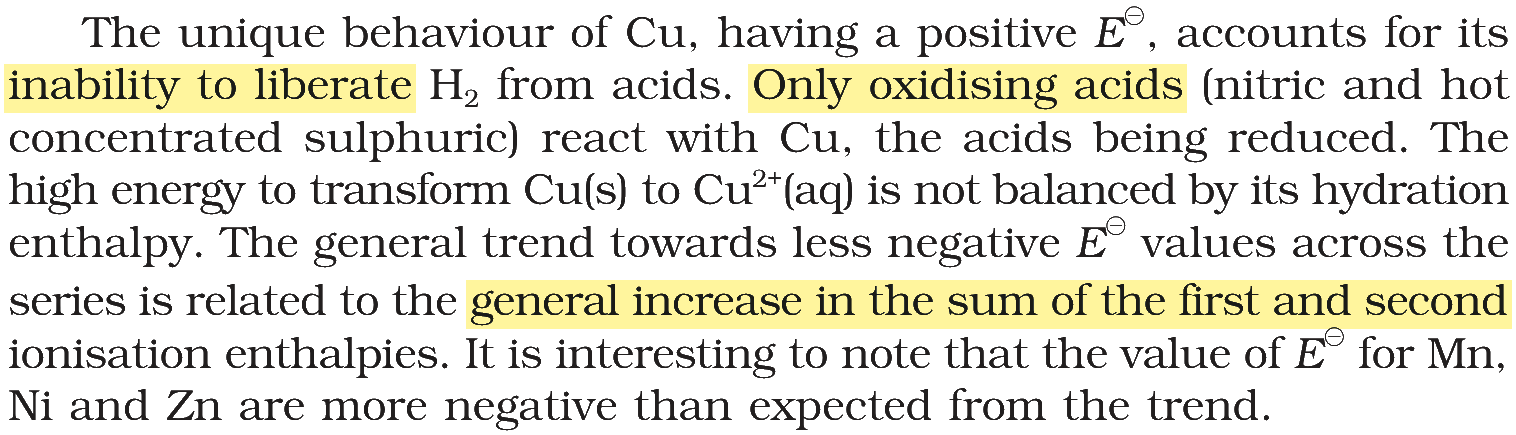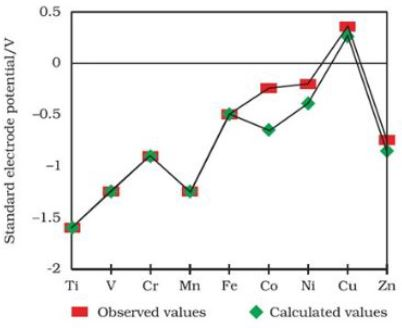
Observed and calculated values for the standard electrode potentials (\( M^{2+}→ M \)) are shown in the figure above. Based on the data shown, which of the following statements are true?
(A) Cu is not able to liberate \( H_2 \) from acid.
(B) Zn is not able to liberate \( H_2 \) from acid.
(C) An increase in the sum of the first and second ionization enthalpies leads to less negative E° values.
(D) Only oxidising acids react with \( Cu \)
Choose the correct answer from the options given below:
Answer & explanation
Correct answer: option 1
The correct answer is Option (1) → (A), (C) and (D) only
A metal with a negative E°(M2+/M) is a better reducing agent than hydrogen, so it can liberate \( \ce{H2} \) from dilute acids; a metal with a positive E° cannot. Across the series Ti to Zn, the E° values become less negative because the energy needed to form M2+ (mainly the sum of the first and second ionisation enthalpies) increases.
(A) Cu is not able to liberate \( \ce{H2} \) from acid. — Correct. In the figure, Cu alone has a positive value (+0.34 V), so it cannot reduce \( \ce{H^{+}} \) to \( \ce{H2} \).
(B) Zn is not able to liberate \( \ce{H2} \) from acid. — Incorrect. Zn has a negative E° (about −0.76 V), so it reduces \( \ce{H^{+}} \): \( \ce{Zn + 2H^+ -> Zn^2+ + H2 ^} \).
(C) An increase in the sum of the first and second ionization enthalpies leads to less negative E° values. — Correct. The more energy needed to remove two electrons, the harder it is to form M2+(aq), and the less negative E° becomes; this is the general trend across the series.
(D) Only oxidising acids react with Cu — Correct. Since Cu cannot reduce \( \ce{H^{+}} \), only acids whose anion is an oxidant (nitric acid, hot concentrated sulphuric acid) react, and the acid itself is reduced: \( \ce{Cu + 4HNO3 -> Cu(NO3)2 + 2NO2 + 2H2O} \).
NCERT (2026-27 edition):
Trends in the M2+/M Standard Electrode Potentials – …