Match List-I with List-II.
| List-I | List-II |
|---|---|
| (A) Intelligence Tests | (I) Actual skills possessed by a person |
| (B) Aptitude Test | (II) Potential to acquire skills |
| (C) Personality Tests | (III) Maturity and value system of a person |
| (D) Trade Test | (IV) Ability to make decisions and judgments |
Choose the correct answer from the options given below:
Answer & explanation
Correct answer: option 3
The correct answer is Option (3) → (A)-(IV), (B)-(II), (C)-(III), (D)-(I)
| List-I | List-II | Reason |
|---|---|---|
| (A) Intelligence Tests | (IV) Ability to make decisions and judgments | This test measures the level of IQ. It shows how well a person learns and how soundly he decides. |
| (B) Aptitude Test | (II) Potential to acquire skills | It tells what a person can learn with training, that is, the capacity to develop. |
| (C) Personality Tests | (III) Maturity and value system of a person | It gives clues to emotions, reactions, maturity and values, the whole personality. |
| (D) Trade Test | (I) Actual skills possessed by a person | It measures the skills a person already has in a trade or profession. |
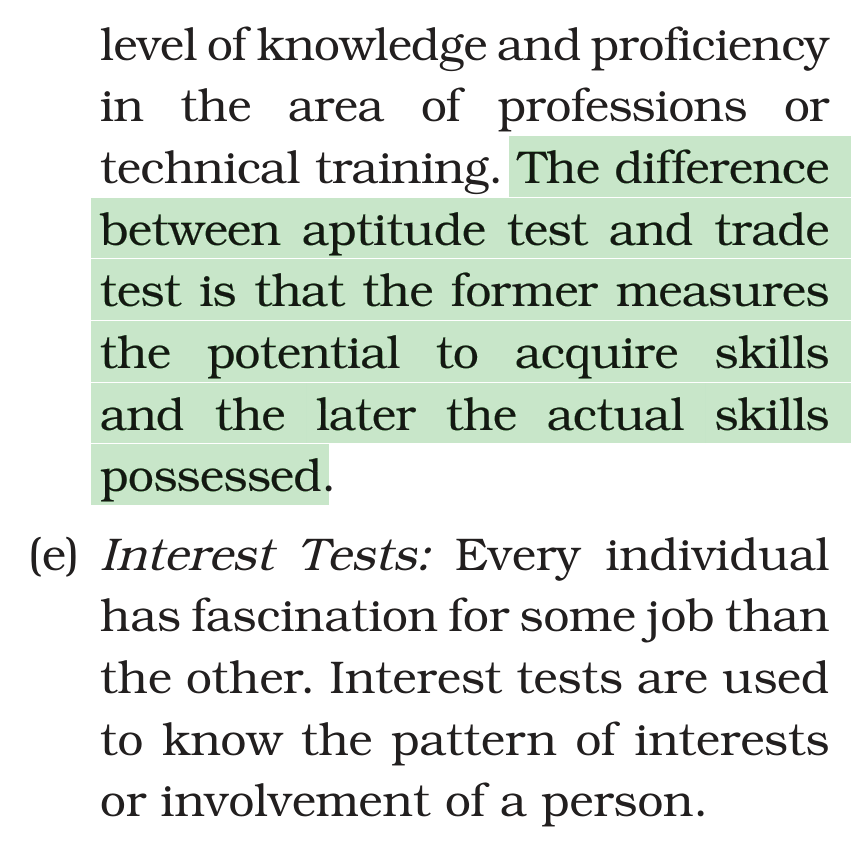
NCERT (2026-27 Edition): “(a) Intelligence Tests: This is one of the important psychological tests used to measure the level of intelligence quotient of an individual. It is an indicator of a person’s learning ability or the ability to make decisions and judgments.” “(c) Personality Tests: Personality tests provide clues to a person’s emotions, her reactions, maturity and value system etc. These tests probe the overall personality. Hence, these are difficult to design and implement.” “(d) Trade Test: These tests measure the existing skills of the individual. …”
|