
The scheme shows the mechanism of esterification of a carboxylic acid (R–COOH) with an alcohol (R′–OH) in the presence of an acid catalyst.
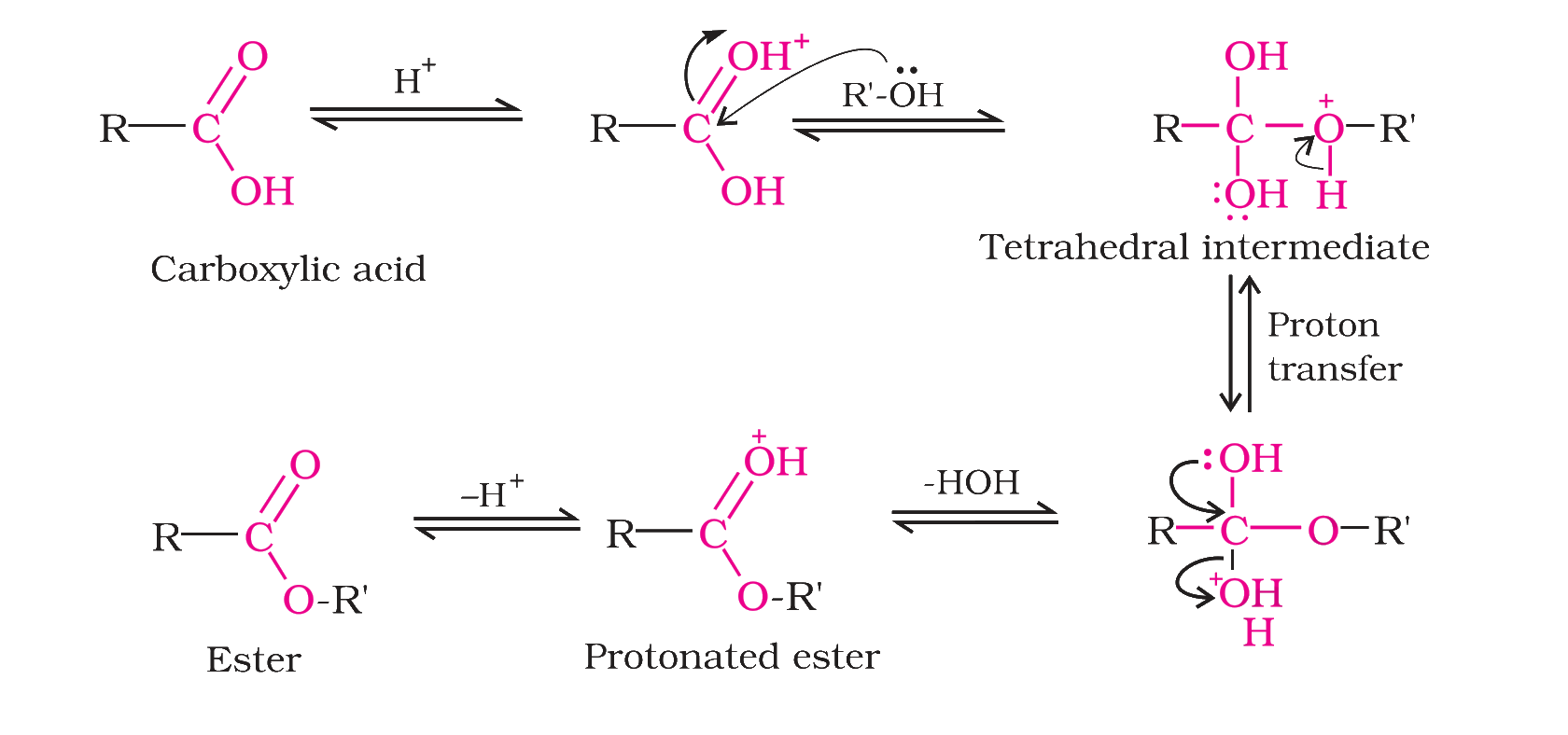
What is the role of the alcohol, R′–OH, in the second step of the mechanism?
Answer & explanation
Correct answer: option 4
The correct answer is Option (4) → It acts as a nucleophile and adds to the carbonyl carbon of the protonated acid.
In the scheme the curved arrow starts at the lone pair on the oxygen of R′–OH and ends at the carbon of the protonated acid. A species that gives an electron pair to a carbon atom is a nucleophile. The protonated carbonyl carbon accepts this pair, and the product is the tetrahedral intermediate, which carries the R′O group on the carbon.
Why the other options are incorrect
Option (1) It acts as a proton donor and protonates the carbonyl oxygen of the acid. — Incorrect. The carbonyl oxygen is protonated in the first step by H+, the acid catalyst, not by the alcohol.
Option (2) It acts as an electrophile and accepts an electron pair from the carbonyl oxygen. — Incorrect. The alcohol gives an electron pair; it does not accept one.
Option (3) It acts as a leaving group and is removed as a water molecule. — Incorrect. The water molecule (–HOH) comes from an –OH group of the acid after proton transfer. The R′O group of the alcohol stays and ends up in the ester.
NCERT (2026-27 edition):
8.9.2 Reactions Involving Cleavage of C–OH Bond – “Mechanism of esterification of carboxylic acids: The esterification of carboxylic acids with alcohols is a kind of nucleophilic acyl substitution. Protonation of the carbonyl oxygen activates the carbonyl group towards nucleophilic addition of the alcohol. Proton transfer in the tetrahedral intermediate converts the hydroxyl group into –+OH2 group, which, being a better leaving group, is eliminated as neutral water molecule. The protonated ester so formed finally loses a proton to give the ester.”
Mechanism of esterification of carboxylic acids