
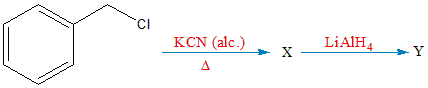
The product \('Y'\) in the following reaction sequence is
Answer & explanation
Correct answer: option 4
The correct answer is Option (4) → 2-phenylethanamine (C6H5CH2CH2NH2)
Reaction of an alkyl halide with alcoholic KCN, followed by reduction of the nitrile, is a way of making an amine with one carbon atom more than the halide (ascent of series). The cyanide ion replaces the halogen by nucleophilic substitution, and \( \ce{LiAlH4} \) reduces –C≡N to –\( \ce{CH2NH2} \).
First, benzyl chloride is converted into phenylethanenitrile (X):
\( \ce{C6H5CH2Cl + KCN} \xrightarrow[\Delta]{\text{alc.}} \ce{C6H5CH2CN + KCl} \)
Then \( \ce{LiAlH4} \) reduces the nitrile to the primary amine (Y):
\( \ce{C6H5CH2CN} \xrightarrow[\text{(ii) }\ce{H2O}]{\text{(i) }\ce{LiAlH4}} \ce{C6H5CH2CH2NH2} \)
So Y is 2-phenylethanamine, with the CN carbon now part of the side chain.
Why the other options are incorrect
Option (1) benzylamine (C6H5CH2NH2) — Incorrect. This has no extra carbon; it is formed when benzyl chloride reacts with ammonia, not through the nitrile.
Option (2) benzyl alcohol (C6H5CH2OH) — Incorrect. This is the product of hydrolysis of benzyl chloride with aqueous KOH; alcoholic KCN gives the nitrile.
Option (3) benzoic acid (C6H5COOH) — Incorrect. An acid is formed by oxidation (for example, of toluene with \( \ce{KMnO4} \)); \( \ce{LiAlH4} \) is a reducing agent.
NCERT (2026-27 edition):
Reduction of Nitriles
