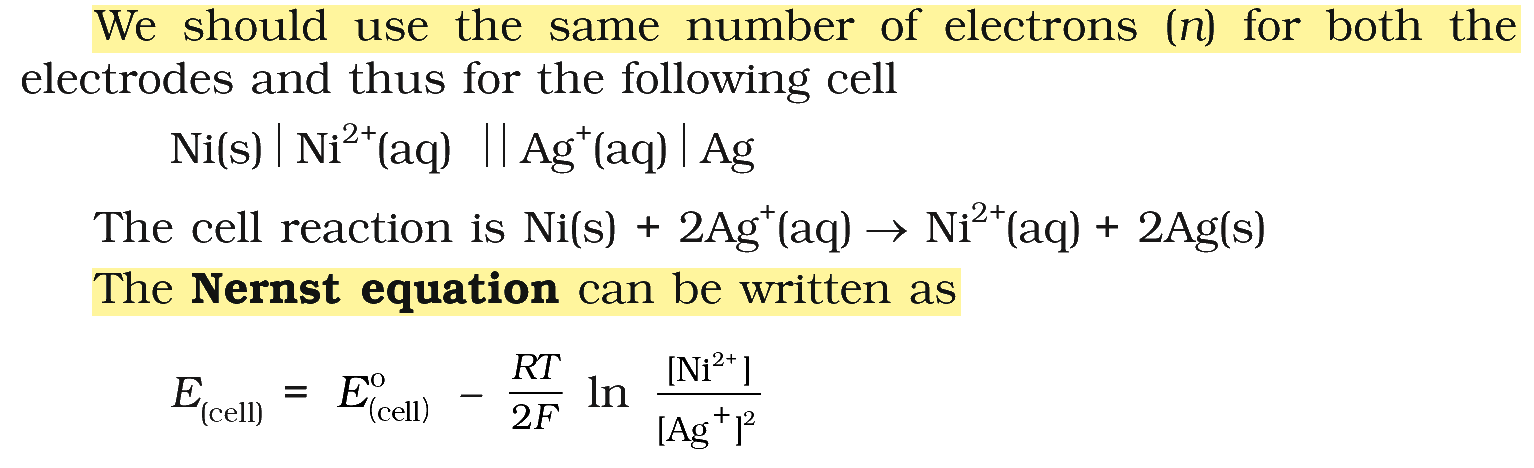
The correct representation of the Nernst equation for the following electrochemical cell at 298 K:
Pt(s) | Cl2(g) (1 bar) | Cl− (0.01M) || H+(0.001M) | H2(g) (0.5 bar) | Pt(s)
Answer & explanation
Correct answer: option 1
The correct answer is Option (1) → \( \displaystyle E_{cell}=E^{o}_{cell}-\frac{0.0591}{2}\log\frac{P_{Cl_2(g)}\times P_{H_2(g)}}{[Cl^-]^2\times[H^+]^2} \)
To write the Nernst equation for a cell, first get the cell reaction from the cell notation. The electrode on the left is the anode, where oxidation happens, and the electrode on the right is the cathode, where reduction happens. Then:
\( \displaystyle E_{cell}=E^{o}_{cell}-\frac{0.0591}{n}\log Q\quad(\text{at }298\ \mathrm{K}) \)
In the reaction quotient Q, products go in the numerator and reactants in the denominator. Gases enter as partial pressures (in bar), ions as molar concentrations, and each term is raised to the power of its coefficient. Pure solids such as Pt are left out.
For the given cell:
\( \displaystyle \text{Anode: }\ce{2Cl^{-}(aq) -> Cl2(g) + 2e^{-}} \)
\( \displaystyle \text{Cathode: }\ce{2H^{+}(aq) + 2e^{-} -> H2(g)} \)
\( \displaystyle \text{Cell: }\ce{2Cl^{-}(aq) + 2H^{+}(aq) -> Cl2(g) + H2(g)},\quad n=2 \)
So \( \ce{Cl2} \) and \( \ce{H2} \) are the products, and \( \ce{Cl^{-}} \) and \( \ce{H^{+}} \) the reactants, each with coefficient 2:
\( \displaystyle Q=\frac{P_{Cl_2(g)}\times P_{H_2(g)}}{[Cl^-]^2\times[H^+]^2} \)
Putting this into the Nernst equation with n = 2 gives Option (1).
Shortcut: Both ions have the coefficient 2, so their concentrations must be squared, which leaves Options (1) and (3). Chlorine gas is formed at the anode, so P\( \ce{Cl2} \) belongs in the numerator. That gives Option (1).
Why the other options are incorrect
Option (2) \( \displaystyle E_{cell}=E^{o}_{cell}-\frac{0.0591}{2}\log\frac{P_{Cl_2(g)}\times P_{H_2(g)}}{[Cl^-]\times[H^+]} \) — Incorrect. The powers are missing. Two \( \ce{Cl^{-}} \) and two \( \ce{H^{+}} \) ions react, so both concentrations must be squared.
Option (3) \( \displaystyle E_{cell}=E^{o}_{cell}-\frac{0.0591}{2}\log\frac{[Cl^-]^2\times P_{H_2(g)}}{P_{Cl_2(g)}\times[H^+]^2} \) — Incorrect. This treats \( \ce{Cl2} \) as a reactant and \( \ce{Cl^{-}} \) as a product, as if chlorine were reduced at the left electrode. But the left electrode is the anode, where \( \ce{Cl^{-}} \) is oxidised to \( \ce{Cl2} \).
Option (4) \( \displaystyle E_{cell}=E^{o}_{cell}-\frac{0.0591}{2}\log\frac{[Cl^-]\times P_{H_2(g)}}{P_{Cl_2(g)}\times[H^+]} \) — Incorrect. This has the chlorine terms on the wrong sides, and the powers of 2 are also missing.
NCERT (2026-27 edition):
Nernst Equation – …