CUETMOCK
  • Pricing
  • Mentors
Log inStart freeStart free mocks→

First test, then trust

Try a free CUET mock test.

Join 5,00,000+ students who rehearsed exam day on the exact NTA screen before sitting CUET. On the web and on Android.

Start free mocks →Get the Android app
CUETMOCK

India's #1 CUET Mock Test Platform. Original NCERT-based questions on the exact NTA exam screen — trusted by 5,00,000+ students since CUET 2022.

Get it onGoogle PlayScan to download the CUETMOCK app

Mock tests

  • CUET mock test series
  • Commerce mocks
  • Humanities (Arts) mocks
  • Science mocks
  • Languages & GAT mocks
  • Free practice questions
  • Pricing

Resources

  • CUET exam guide
  • CUET syllabus
  • Universities accepting CUET
  • Expert blogs
  • News & notifications
  • Webinars & counselling
  • CUET score calculator
  • How we estimate your rank
  • FAQs

Company

  • About us
  • Our leadership & team
  • Our toppers
  • Mentors
  • For schools
  • Contact us
  • Terms
  • Privacy
  • Refund policy

Talk to us

+91 7696 6630 56info@cuetmock.comWhatsApp us

Our other platforms

  • JEE Mock — For IIT-JEE aspirants
  • NEET Mock — For NEET aspirants

Newsletter

Exam updates, study material and offers — no spam.

© 2026 NYC Ventures Pvt. Ltd.

701-702, Royal Business Park, Zirakpur, Punjab - 140603

  • Terms of use
  • Privacy policy
  • Refund policy
  • Contact us

iCUETMOCK is an independent preparation platform, not affiliated with the National Testing Agency (NTA). Always check exam details on the official NTA website.

  • Home
  • Mock tests
  • CUET guide
  • Pricing
  • Log in
Home/Practice questions/History
HistoryModern India: Mahatma Gandhi and the Nationalist movement

Arrange the following events in chronological order: A. Swadeshi Move…

Arrange the following events in chronological order:

A. Swadeshi Movement.
B. Mahatma Gandhi left India to study law.
C. Non-Cooperation Movement.
D. Ahmedabad mill workers' Movement.
E. Speech of Gandhi at Banaras Hindu University.

Choose the correct answer from the options given below:

Answer & explanation+

Correct answer: option 4

The correct answer is Option (4) → B, A, E, D, C

(B) Mahatma Gandhi left India to study law. — before 1893. Gandhiji was a lawyer trained in London, and he later went to South Africa as a lawyer. The India he came back to in 1915 was different from the one he had left in 1893, so his going abroad to study law comes first of the five.

(A) Swadeshi Movement. — 1905-07. Through it the Congress greatly broadened its appeal among the middle classes.

(E) Speech of Gandhi at Banaras Hindu University. — February 1916. His first major public appearance was at the opening of the Banaras Hindu University.

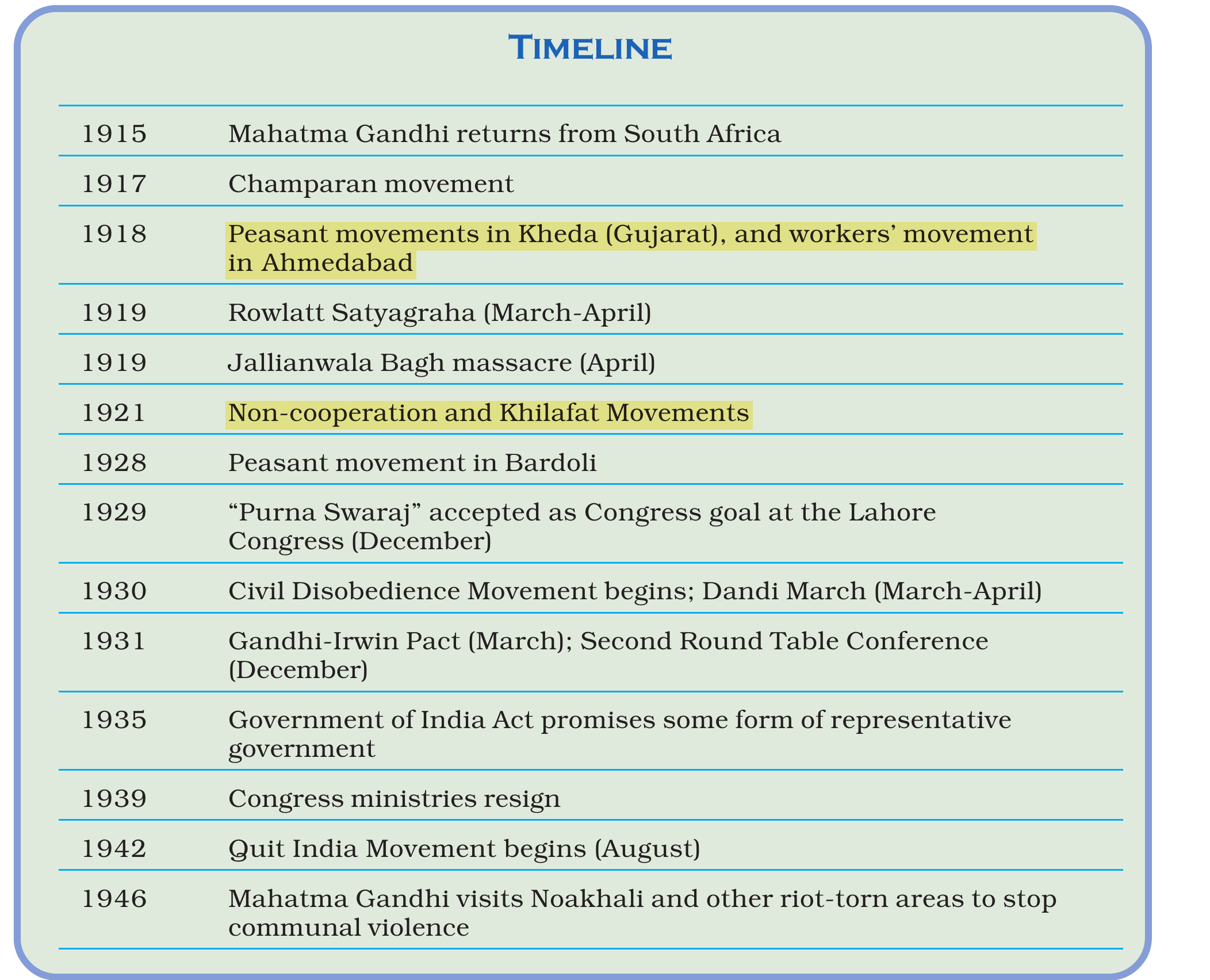
(D) Ahmedabad mill workers’ Movement. — 1918. Gandhiji intervened in a labour dispute in Ahmedabad, demanding better working conditions for the textile mill workers.

(C) Non-Cooperation Movement. — 1921, with the Khilafat Movement.


NCERT (2026-27): “1. A Leader Announces Himself … In January 1915, Mohandas Karamchand Gandhi returned to his homeland after two decades of residence abroad. These years had been spent for the most part in South Africa, where he went as a lawyer, and in time became a leader of the Indian community in that territory.…

1. A Leader Announces Himself … The India that Mahatma Gandhi came back to in 1915 was rather different from the one that he had left in 1893. Although still a colony of the British, it was far more active in a political sense. The Indian National Congress now had branches in most major cities and towns. Through the Swadeshi movement of 1905-07 it had greatly broadened its appeal among the middle classes. That movement had thrown up some towering leaders – among them Bal Gangadhar Tilak of Maharashtra, Bipin Chandra Pal of Bengal, and Lala Lajpat Rai of Punjab. The three were known as ‘Lal, Bal and Pal’, the alliteration conveying the all-India character of their struggle, since their native provinces were very distant from one another. Where these leaders advocated militant opposition to colonial rule, there was a group of ‘Moderates’ who preferred a more gradual and persuasive approach. Among these Moderates was Gandhiji’s acknowledged political mentor, Gopal Krishna Gokhale, as well as Mohammad Ali Jinnah, who, like Gandhiji, was a lawyer of Gujarati extraction trained in London. On Gokhale’s advice, Gandhiji spent a year travelling around British India, getting to know the land and its peoples. His first major public appearance was at the opening of the Banaras Hindu University (BHU) in February 1916.…

2. The Making and Unmaking of Non-cooperation … The following year, 1918, Gandhiji was involved in two campaigns in his home state of Gujarat. First, he intervened in a labour dispute in Ahmedabad, demanding better working conditions for the textile mill workers.…”

NCERT extract

Advertisement

Practise more on Modern India: Mahatma Gandhi and the Nationalist movement

Chapter-wise mocks on the real NTA exam screen, with solutions and your rank. Your first mocks are free.

Start free mocks →

Advertisement

Next questions

  1. SHGs stands for:Economics · Indian Economic Development: Rural Development
  2. If tan^-1 x + 2 cot^-1x =(2π)/3, then x =Maths. Section B1 · Inverse Trigonometric Functions
  3. Consider the following statements(A) Corpuscular model predicted that if the ray of light bends towards the normal after refraction then th…Physics · Wave Optics
  4. Choose the appropriate example of the Adverb of Frequency:English · Grammar: Adverb
  5. How many times Mithali Raj played in ICC Women's Cricket World Cup?General Aptitude Test · Current Affairs
  6. In the Union Budget 2024-25, the Short Term Capital Gains Tax has been increased to how much?General Aptitude Test · Current Affairs
  7. Which of the following is not one of the method of valuation of goodwill?Accountancy Part A · Admission of a Partner
  8. A firm makes heavy machines used in factories. Its buyers are a small number of industrial firms. Because of this nature of its product and…Business Studies · Marketing
  9. The rate law for a reaction between the substances A and is given by Rate = k[A]n [B]m: On doubling the concentration of A and halving the…Chemistry · Physical: Chemical Kinetics
  10. If the cash equivalent of a perpetuity of Rs. 1200 payable at the end of each quarter is Rs. 96000, then the rate of interest convertible q…Applied Maths. Section B2 · Financial Mathematics