
Select the incorrect statement from the following:
Answer & explanation
Correct answer: option 2
The correct answer is Option (2) → lanthanoids show greater range of oxidation state than Actinoids
The lanthanoids (4f series) and actinoids (5f series) are compared on the energies and extent of their f orbitals:
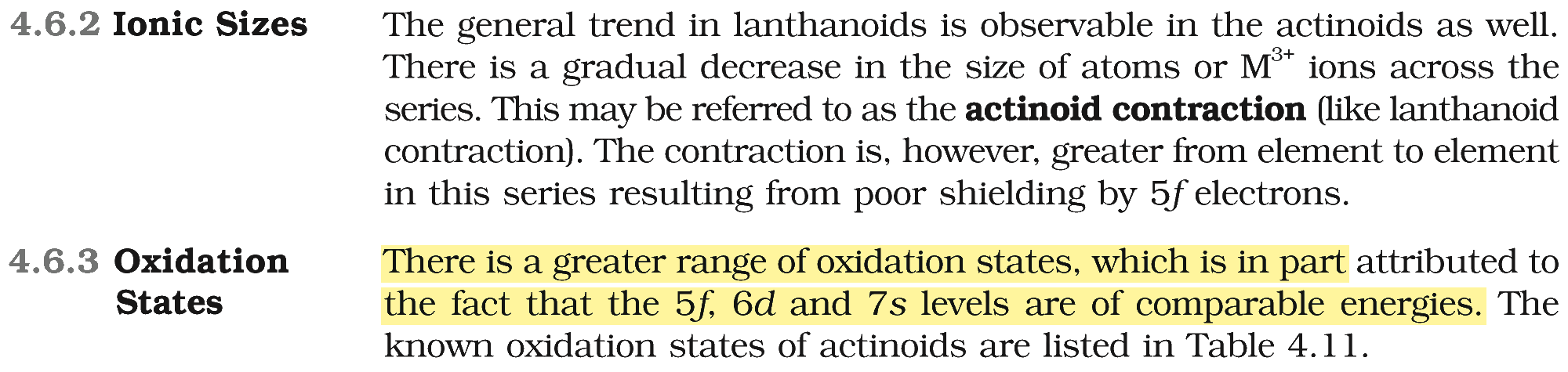
In the actinoids the 5f, 6d and 7s subshells have comparable energies, so a varying number of electrons can take part in bonding.
In the lanthanoids the 4f electrons are buried deep inside, so the common oxidation state is +3, with only a few +2 and +4 states.
Option (1) 5f electrons are more effectively shielded from the nuclear charge than the 4f electrons — A correct statement. The outer electrons of actinoids are held less firmly, so actinoids have lower ionisation enthalpies and use more electrons in bonding.
Option (2) lanthanoids show greater range of oxidation state than Actinoids — The incorrect statement. The actinoids show the wider range (up to +6 in U and +7 in Np), because their 5f, 6d and 7s levels have comparable energies; lanthanoids mostly show +3.
Option (3) Actinoid series consist more of radioactive elements than lanthanoids — A correct statement. The actinoids are radioactive elements, while among the lanthanoids only promethium is.
Option (4) Actinoid contraction causes stronger effects than Lanthanoid contraction — A correct statement. The decrease in size from one element to the next is greater in the actinoids, because one 5f electron shields another poorly.
NCERT (2026-27 edition):
The Actinoids – “… The actinoids are radioactive elements and the earlier members have relatively long half-lives …”
General Characteristics and Comparison with Lanthanoids – “… The 5f electrons, will therefore, be more effectively shielded from the nuclear charge than the 4f electrons of the corresponding lanthanoids. Because the outer electrons are less firmly held, they are available for bonding in the actinoids.”