

\(A\) and \(B\), respectively from the following options are:
Answer & explanation
Correct answer: option 3
The correct answer is option 2. 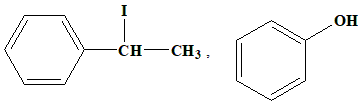
Although ethers are relatively inert toward reaction, they usually show good solvent properties for many nonpolar organic compounds. This strong dissolving power coupled with low reactivity makes ethers good solvents in which to run reactions.
An acid‐catalyzed cleavage that occurs when hydriodic acid \((HI)\) mixes with ethers is the most significant reaction that ethers experience. This reaction proceeds via a nucleophilic substitution mechanism. Primary and secondary alkyl ethers react by an \(S_N2\) mechanism, while tertiary, benzylic, and alcylic ethers cleave by an \(S_N1\) mechanism. A typical \(S_N2\) reaction would be the reaction of ethylisopropyl ether with HI. The mechanism for this reaction is:
