Which among the following solids is an example of ionic solid ?
Answer & explanation
Correct answer: option 2
The correct answer is Option (2) → NaCl, MgO, ZnS
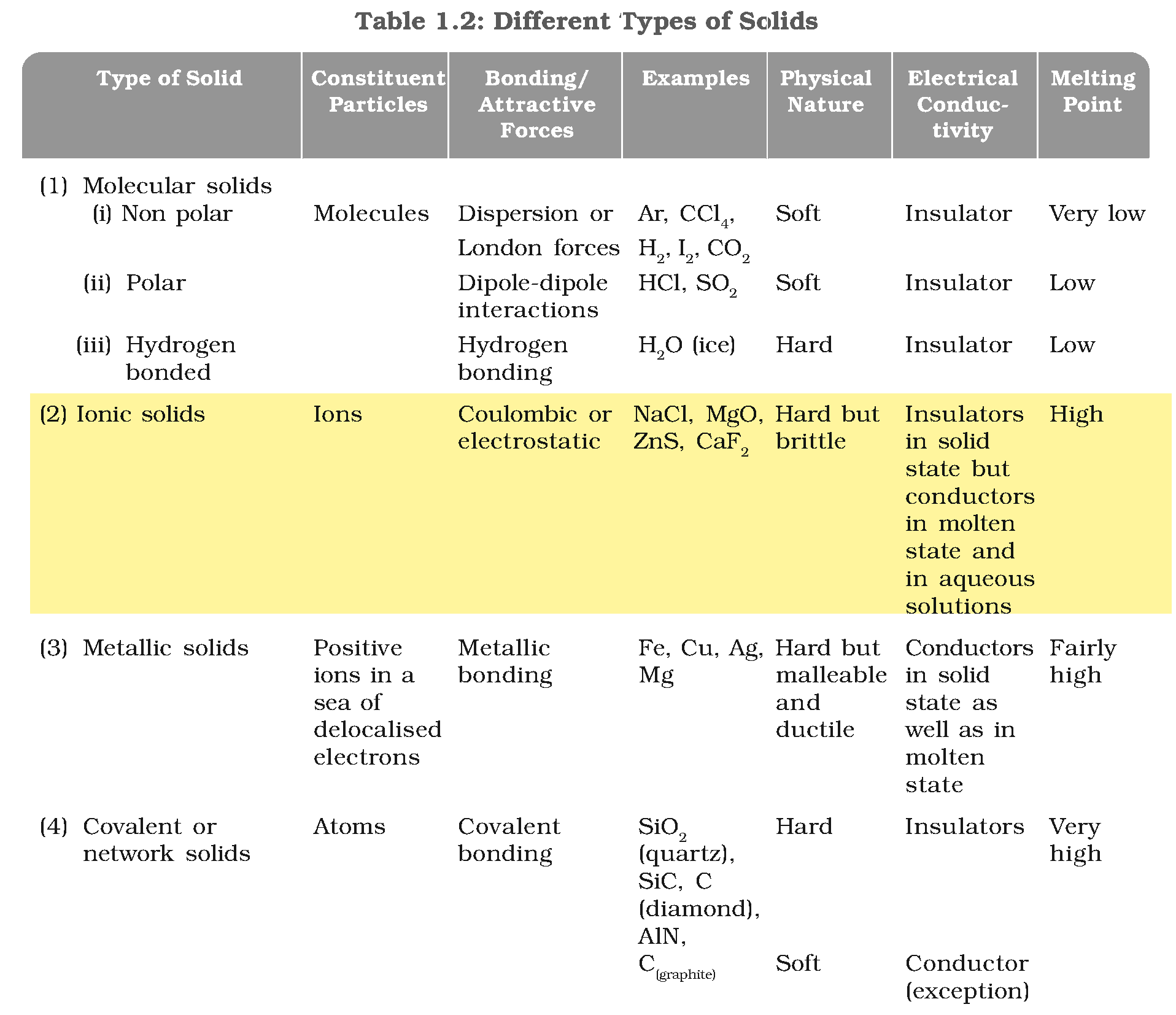
Crystalline solids are classified by the nature of the forces between their constituent particles into four types: molecular solids (molecules held by dispersion, dipole-dipole or hydrogen-bonding forces), ionic solids (cations and anions held by strong coulombic forces), metallic solids (positive ions in a sea of delocalised electrons) and covalent or network solids (atoms joined by covalent bonds throughout the crystal).
NaCl (\( \ce{Na^{+}} \) and \( \ce{Cl^{-}} \)), MgO (\( \ce{Mg^{2+}} \) and \( \ce{O^{2-}} \)) and ZnS (\( \ce{Zn^{2+}} \) and \( \ce{S^{2-}} \)) are built of ions held by electrostatic attraction, so they are ionic solids: hard, brittle, high-melting, insulators in the solid state but conductors when molten or dissolved.
Why the other options are incorrect
Option (1) Fe, Cu, Ag, Mg — Incorrect. These are metallic solids; their positive ions sit in a sea of mobile electrons, which is why they conduct electricity in the solid state.
Option (3) Ar, CCl4 — Incorrect. These are non-polar molecular solids, held only by weak dispersion (London) forces, so they are soft and melt at very low temperatures.
Option (4) SiO2, SiC — Incorrect. These are covalent (network) solids; every atom is covalently bonded to its neighbours, which makes them very hard with very high melting points.
Note: This question is from the pre-rationalised NCERT book (2022-23). The topic is not there in the latest NCERT book (2026-27), and it is also out of the CUET 2026 syllabus.
NCERT (Pre-rationalised edition, 2022-23):
Different Types of Solids