
Find the area of the region: $\{ (x, y) : 0 \leq y \leq x^2 + 1, 0 \leq y \leq x + 1, 0 \leq x \leq 2 \}$
Answer & explanation
Correct answer: option 1
The correct answer is Option (1) → $\frac{23}{6}$
Let us first sketch the region whose are is to be found out. This region is the intersection of the following regions:
$A_1 = \{ (x, y) : 0 \leq y \leq x^2 + 1 \}$,
$A_2 = \{ (x, y) : 0 \leq y \leq x + 1 \}$
and $A_3 = \{ (x, y) : 0 \leq x \leq 2 \}$
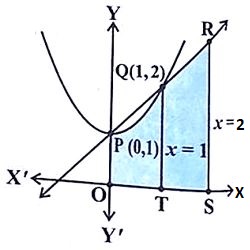
The points of intersection of $y = x^2 + 1$ and $y = x + 1$ are points $P(0, 1)$ and $Q(1, 2)$. From Figure, the required region is the shaded region $OPQRST$ whose area:
$= \text{area of the region } OTQPO + \text{area of the region } TSRQT$
$= \int\limits_{0}^{1} (x^2 + 1) \, dx + \int\limits_{1}^{2} (x + 1) \, dx$
$= \left[ \left(\frac{x^3}{3} + x\right) \right]_{0}^{1} + \left[ \left(\frac{x^2}{2} + x\right) \right]_{1}^{2}$
$= \left[ \left( \frac{1}{3} + 1 \right) - 0 \right] + \left[ (2 + 2) - \left( \frac{1}{2} + 1 \right) \right] = \frac{23}{6}$